Injectable hyaluronic acid brands: complete guide to choosing well
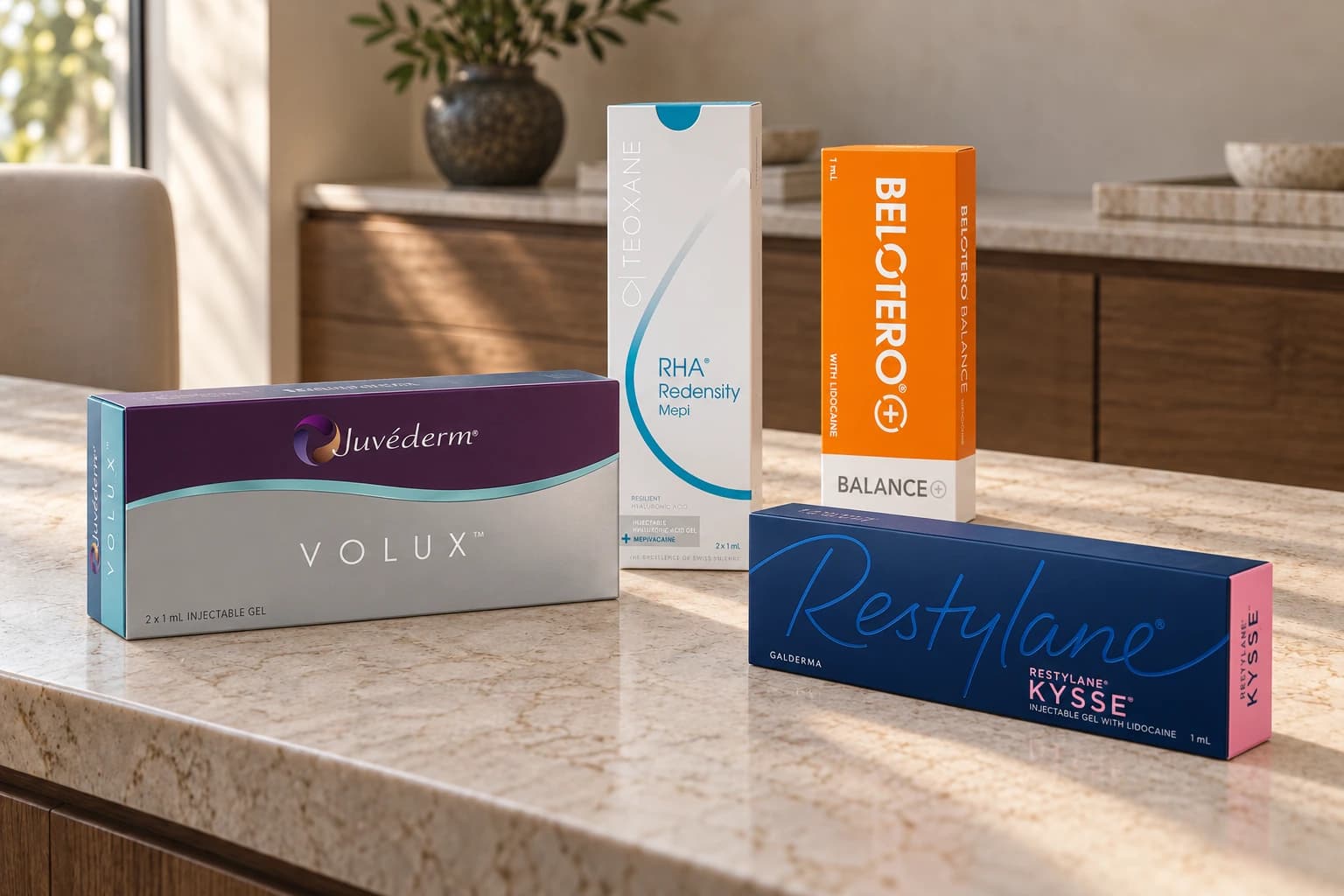
The four brands of injectable hyaluronic acid (HA) with the strongest regulatory approval and clinical evidence worldwide are Juvéderm (Allergan / AbbVie), Restylane (Galderma), Teoxane RHA (Teosyal), and Belotero (Merz). All have FDA approval and European CE marking, and each uses its own cross-linking technology that determines the gel texture, projection capacity, behavior with movement, and tissue duration.
Choosing a brand is not like choosing a consumer product: there is no "best" one in abstract. The decision depends on the treatment zone (lips, cheekbones, jawline, under-eye circles, folds, or general skin), the desired result, and above all, the experience of the physician administering injections. A skilled injector selects the brand and specific reference — and sometimes combines them — according to each patient's anatomical needs.
This guide explains the real differences between brands, their regulatory approvals in different countries, which product is best for each facial zone, and what red flags indicate that a product is not safe.
Summary
- Four brands dominate the regulated market: Juvéderm (Vycross technology), Restylane (NASHA / XpresHAn), Teoxane RHA (low cross-linking), and Belotero (CPM). All are hyaluronic acid-based and all are reversible with hyaluronidase.
- There is no "universal best brand": each line has products optimized for different zones. The correct choice is product + zone + physician technique.
- Regulatory approval matters: in Latin America, verify that the product has registration with COFEPRIS (Mexico), ANVISA (Brazil), or INVIMA (Colombia), in addition to FDA or CE marking.
- Skinboosters are a new category: Skinvive/Volite (Allergan), Restylane Skinbooster (Galderma), and Profhilo (IBSA) improve skin quality without adding volume.
- Avoid unregistered brands and needle-free devices: "hyaluron pens" are not FDA-approved and the agency itself issued an alert in 2021 about permanent injuries associated with their use.
What differentiates one brand from another: cross-linking technology
What distinguishes injectable hyaluronic acid brands is not the molecule — all use the same substance, hyaluronic acid — but the process of cross-linking: the way HA chains chemically interweave to form a stable gel that resists enzymatic degradation by the body.
The degree, pattern, and technology of cross-linking determine three key clinical properties:
- Cohesivity — how well the gel stays together after injection. A highly cohesive gel (like Juvéderm Volux) projects and sustains; a less cohesive one (like Belotero Balance) integrates more diffusely into the dermis.
- Viscosity and elasticity (G') — defines whether the product is firm (ideal for structuring jawline or chin) or flexible (ideal for lips or dynamic zones like nasolabial folds when smiling).
- Clinical duration — generally, more cross-linking and higher HA concentration = longer permanence, although the injection zone and individual metabolism also play a role.
Technologies by brand
| Brand | Technology | Main characteristic |
|---|---|---|
| Juvéderm (Allergan/AbbVie) | Vycross | Mix of low and high molecular weight HA, high cohesivity, lower water absorption |
| Restylane (Galderma) | NASHA and XpresHAn | NASHA: firm gel, uniform particle size. XpresHAn: flexible gel, designed for movement zones |
| Teoxane RHA (Teosyal) | Resilient hyaluronic acid | Lower cross-linking than competitors; closer to body's natural HA, high dynamic flexibility |
| Belotero (Merz) | CPM (Cohesive Polydensified Matrix) | Non-uniform cross-linking within the same gel; low viscosity, homogeneous integration into dermis |
In practice, these technological differences are relevant, but do not mean one brand is inherently superior. Each technology was designed to optimize a type of result: Vycross prioritizes duration and cohesivity; XpresHAn prioritizes natural movement; RHA seeks to mimic native HA; CPM seeks subtle dermal integration.
Brands approved by the FDA and COFEPRIS
Regulatory approvals confirm that a product was evaluated in controlled clinical studies of safety and efficacy. The FDA (United States), COFEPRIS (Mexico), CE marking (Europe), ANVISA (Brazil), and INVIMA (Colombia) are the reference agencies in the Americas and Europe.
| Brand / Product | FDA (U.S.) | COFEPRIS (Mexico) | CE (Europe) | ANVISA (Brazil) | INVIMA (Colombia) |
|---|---|---|---|---|---|
| Juvéderm Voluma XC | ✅ | ✅ | ✅ | ✅ | ✅ |
| Juvéderm Volux XC | ✅ | ✅ | ✅ | ✅ | ✅ |
| Juvéderm Volbella XC | ✅ | ✅ | ✅ | ✅ | ✅ |
| Juvéderm Volift | ❌ (not commercialized in U.S.) | ✅ | ✅ | ✅ | ✅ |
| Skinvive / Volite | ✅ (Skinvive) | ✅ (Volite) | ✅ (Volite) | ✅ | ✅ |
| Restylane (complete line) | ✅ | ✅ | ✅ | ✅ | ✅ |
| Restylane Skinbooster | ❌ | ✅ | ✅ | ✅ | ✅ |
| Teoxane RHA 2, 3, 4 | ✅ | ✅ | ✅ | ✅ | ✅ |
| Teoxane RHA Redensity | ✅ | ✅ | ✅ | ✅ | ✅ |
| Teoxane RHA Kiss | ❌ | ✅ | ✅ | — | — |
| Belotero Balance | ✅ | ✅ | ✅ | ✅ | ✅ |
| Belotero Volume | ❌ | ✅ | ✅ | — | ✅ |
| Profhilo | ❌ | ✅ | ✅ | — | ✅ |
Key data:
- Juvéderm Volux XC is the only HA filler with specific FDA approval for jawline definition (approved in August 2022).
- Skinvive (known as Volite outside the U.S.) was the first HA microdroplet injectable approved by the FDA for improving skin smoothness (May 2023).
- RHA Redensity received FDA approval in December 2021 for dynamic perioral wrinkles (code PMA P170002/S012).
- Restylane Skinbooster and Profhilo do not have FDA approval in the United States but do have CE marking and extensive use history in Europe, Latin America, and Asia.
For patients in Mexico: COFEPRIS is the agency that ensures the imported product meets quality, sterility, and traceability standards. Require your physician to show you the sealed syringe with lot label before application.
Comparison by treatment zone
The most useful question is not "what is the best brand?" but "what is the best product for the zone I want to treat?". Each facial zone has different requirements for firmness, flexibility, and injection depth.
Lips (volume, contour, and definition)
| Product | Brand | Main advantage | Estimated duration |
|---|---|---|---|
| Juvéderm Volbella XC | Allergan | Soft gel, ideal for natural lips and perioral lines; contains lidocaine | 9–12 months |
| Teoxane RHA Kiss | Teoxane | Designed specifically for lips; high flexibility when speaking and moving | 9–12 months |
| Restylane Kysse | Galderma | XpresHAn technology, natural movement; FDA-approved for lips | 9–12 months |
| Belotero Lips | Merz | CPM, subtle integration, ideal for conservative results | 6–9 months |
For most patients seeking natural results, Volbella and RHA Kiss are the most widely used options in specialized clinics. The choice between them depends on the injector's preferred technique and whether the goal is more contour (Volbella) or more mobility (RHA Kiss).
Cheekbones and midface
| Product | Brand | Main advantage | Estimated duration |
|---|---|---|---|
| Juvéderm Voluma XC | Allergan | High projection and lifting capacity; deep injection | 12–18 months |
| Restylane Lyft | Galderma | NASHA, structural firmness, also approved for hands | 12–15 months |
| Belotero Volume | Merz | CPM, volume with subtle integration | 12–15 months |
Juvéderm Voluma is the product with the most published evidence for malar volume restoration, and is frequently the first choice in this zone.
Jawline and chin
| Product | Brand | Main advantage | Estimated duration |
|---|---|---|---|
| Juvéderm Volux XC | Allergan | Only HA FDA-approved specifically for jawline; maximum cohesivity in the Vycross family | 12–18 months |
| Restylane Defyne | Galderma | XpresHAn, definition with natural movement | 12–15 months |
Volux is the current reference for jawline definition with hyaluronic acid: its high G' (elastic modulus) allows it to resist compressive forces in a high-mobility zone.
Nasolabial folds and marionette lines
| Product | Brand | Main advantage | Estimated duration |
|---|---|---|---|
| Juvéderm Volift | Allergan | Vycross; versatility between lips and folds; good moderate projection | 12–15 months |
| Restylane Defyne / Refyne | Galderma | XpresHAn; Defyne for deep folds, Refyne for mild folds | 12 months |
| RHA 3 / RHA 4 | Teoxane | Designed for dynamic wrinkles; RHA 4 for deep folds | 12–15 months |
| Belotero Balance | Merz | CPM, dermal integration, ideal for fine or superficial folds | 6–9 months |
Nasolabial folds are a high-demand zone and practically every brand offers a competent product. RHA 3 and RHA 4 have the distinction of being specifically studied for "dynamic" wrinkles (those that change with expression), which represents an advantage when the patient seeks natural movement.
Under-eye area (tear trough)
| Product | Brand | Main advantage | Estimated duration |
|---|---|---|---|
| Teoxane RHA Redensity 2 | Teoxane | Formulated with amino acids, antioxidants, and vitamins in addition to HA; low hygroscopicity, reduces risk of Tyndall effect | 9–12 months |
| Belotero Balance | Merz | CPM with low viscosity, very homogeneous dermal integration; minimal risk of irregularities | 6–9 months |
| Restylane Eyelight | Galderma | Designed specifically for the infraorbital area | 9–12 months |
The tear trough zone is technically the most demanding on the face due to extremely thin skin and proximity to vessels and orbital structures. Here the choice of injecting physician matters as much as, or more than, the brand. Teoxane Redensity 2 was one of the first products intentionally formulated for this zone, and its low capacity to absorb water helps minimize persistent swelling that can occur with more hygroscopic products.
Skinboosters (skin quality, without volume)
| Product | Brand | Mechanism | Estimated duration |
|---|---|---|---|
| Skinvive / Volite | Allergan | Intradermal microdroplets of Vycross HA; hydration and smoothness | 6–9 months |
| Restylane Skinbooster | Galderma | NASHA in microinjections; deep hydration | 6–9 months (with 3-session protocol) |
| Profhilo | IBSA | High and low molecular weight HA stabilized thermally (without cross-linking); collagen and elastin biostimulation | 6 months (2-session protocol) |
Skinboosters are described in more detail in their own section below.
Juvéderm (Allergan / AbbVie)
Juvéderm is the world's best-selling HA filler family and the one with the most FDA approvals for specific facial zones (10 approved indications). All products in the current line use Vycross technology, which combines low and high molecular weight hyaluronic acid chains to achieve a cohesive, long-lasting gel with less tendency to absorb water (which reduces post-injection swelling).
Product line
- Voluma XC — Midface volume (cheekbones, cheeks). Deep injection, subcutaneous or supraperiosteal. Clinical duration of up to 18-24 months in some studies.
- Volux XC — Jawline and chin definition. The firmest and most cohesive gel in the family. Only HA with specific FDA approval for jawline (August 2022).
- Volbella XC — Lips and perioral lines. Soft, low-concentration gel. Natural result, especially valued in patients seeking their first lip augmentation.
- Volift (not available in U.S., marketed elsewhere) — Nasolabial folds, marionette lines, and lips in cases of moderate volume. Occupies the space between Volbella and Voluma.
- Skinvive / Volite — Intradermal skinbooster. Does not add volume; improves skin texture, hydration, and smoothness. FDA-approved in May 2023 under the name Skinvive; marketed as Volite in Mexico and Europe.
Juvéderm advantages
- Highest number of FDA-approved indications.
- Vycross technology well-documented with over a decade of clinical use.
- Complete range covering from skin (Skinvive) to bone structure (Volux).
- All products contain integrated lidocaine for greater comfort.
Limitations
- Some physicians consider Vycross products slightly more hygroscopic than RHA or Belotero in zones like under-eye, where that water absorption can generate persistent swelling.
- Volift is not available in the United States, limiting intermediate options in that market.
Teoxane (Teosyal / RHA)
Teoxane is a Swiss company whose RHA (Resilient Hyaluronic Acid) line stands out by using the minimum cross-linking necessary to achieve a stable gel, seeking to make the material behave more like the body's natural hyaluronic acid. This approach produces fillers with high dynamic flexibility: they adapt well to facial movement and tend to generate less rigidity when gesturing.
Key product line
- RHA 2 — Moderate dynamic wrinkles. Injection into mid to deep dermis.
- RHA 3 — Moderate to severe dynamic wrinkles; also FDA-approved for lip augmentation (October 2023).
- RHA 4 — Deep wrinkles and folds; the firmest gel in the RHA line, for deep injection.
- RHA Redensity — Dynamic perioral wrinkles (FDA-approved December 2021, PMA P170002/S012). The product with the least cross-linking in the line; includes non-cross-linked HA chains.
- RHA Kiss — Designed specifically for lips. No FDA approval in the U.S. but has CE marking and COFEPRIS registration. Its formulation seeks lip volume with maximum natural movement.
- Redensity 2 (Teosyal Redensity 2) — Formulated for the tear trough (under-eye area). Contains a dermo-restructuring complex with amino acids, antioxidants, and minerals in addition to HA. One of the most widely used options globally for this delicate zone.
Teoxane RHA advantages
- "Resilient" concept: less cross-linking, more mimicry of natural HA.
- RHA 2, 3, and 4 have FDA approval with specific indication for dynamic wrinkles.
- Redensity 2 is one of the few products with formulation specifically for under-eye area.
- RHA Kiss offers lip results with very natural mobility.
Limitations
- RHA Kiss does not have FDA approval (it does have CE and COFEPRIS), which may be a factor in markets where this approval is required.
- The line has fewer long-term published studies than Juvéderm.
- Does not have a high cohesivity product comparable to Volux for jawline definition.
Restylane (Galderma)
Restylane was the first hyaluronic acid filler approved by the FDA (2003) and was pioneering in NASHA technology (Non-Animal Stabilized Hyaluronic Acid): uniform-size gel particles that produce a firm and predictable result. Since then, Galderma added XpresHAn technology, designed to create more flexible gels that move with facial expressions.
Key product line
- Restylane / Restylane-L — Nasolabial folds and moderate wrinkles. NASHA technology.
- Restylane Lyft — Midface volume (cheekbones) and dorsal hand. NASHA, firm gel.
- Restylane Defyne — Deep folds, chin. XpresHAn, flexibility with support.
- Restylane Refyne — Mild to moderate folds. XpresHAn, softer gel than Defyne.
- Restylane Kysse — Lips. XpresHAn, designed for natural lip movement.
- Restylane Contour — Midface, temples. XpresHAn, recent approvals in EU and U.S.
- Restylane Eyelight — Infraorbital zone (under-eye area). Formulation specific to that area.
- Restylane Skinbooster (Vital / Vital Light) — Skinbooster of intradermal microinjections. SB-NASHA technology. Extensive use in Europe and Latin America for over 15 years. Does not have FDA approval in the U.S. but has CE marking and COFEPRIS registration.
Restylane advantages
- Broadest product line on the market: there is a product for practically every zone and indication.
- Dual technology platform (NASHA + XpresHAn) allows selection of firmness or flexibility as needed.
- Longest safety history in the market (over 20 years since first FDA approval).
- Restylane Skinbooster is the skinbooster with the most published clinical studies worldwide.
Limitations
- Does not have an FDA-approved product specifically for jawline (unlike Volux).
- Restylane Skinbooster is not FDA-approved, which may be relevant for patients who prioritize that certification.
Belotero (Merz)
Belotero uses CPM technology (Cohesive Polydensified Matrix), a continuous cross-linking process that produces a gel with variable densities within the same syringe. This property allows very homogeneous tissue integration: the gel distributes smoothly into the dermis without creating visible irregularities.
Key product line
- Belotero Balance — Moderate folds, fine lines, lips (contour). FDA-approved. The most popular reference in the line. HA concentration: 22.5 mg/mL.
- Belotero Intense — Deep folds, lips (volume). CE + COFEPRIS. 25.5 mg/mL.
- Belotero Volume — Facial volume restoration (cheekbones, temples). CE + COFEPRIS. 26 mg/mL. Not FDA-approved.
- Belotero Soft — Superficial fine lines (crow's feet, perioral). CE + COFEPRIS. 20 mg/mL.
- Belotero Lips — Specific for lips. CE.
- Belotero Revive — Skinbooster / biorevitalization. CE.
Belotero advantages
- Excellent dermal integration, especially in thin-skin zones (under-eye, perioral, hand dorsum).
- Belotero Balance is considered by many injectors as one of the safest options for the tear trough due to its low viscosity and minimal hygroscopicity.
- CPM technology allows superficial injection with low risk of irregularities or Tyndall effect.
Limitations
- Lower average clinical duration compared to Vycross or NASHA in volume zones (cheekbones, jawline).
- Only Belotero Balance has FDA approval; the rest of the line depends on CE and local registrations.
- Lower market presence in Latin America compared to Juvéderm and Restylane.
Skinboosters: the new category
Skinboosters are hyaluronic acid injectables designed to improve skin quality — hydration, luminosity, texture, smoothness — without adding volume or changing facial contours. They are applied in microdroplets or micropunctures into the dermis, generally on cheeks, neck, décolletage, and hand dorsum.
This category grew significantly in recent years and currently there are three main options:
Skinvive / Volite (Allergan / AbbVie)
Skinvive is the first and only HA microdroplet injectable approved by the FDA for improving skin smoothness on cheeks (approved in May 2023). Outside the United States it is marketed as Volite. It uses Vycross technology. It is applied in a single session and results last approximately 6 to 9 months.
Restylane Skinbooster (Galderma)
Restylane Skinbooster has been on the European market for over 15 years and is the skinbooster with the most published clinical studies. It uses SB-NASHA technology. The standard protocol includes 3 sessions separated by 2-4 weeks, followed by maintenance sessions every 6 months. It does not have FDA approval but does have CE marking and COFEPRIS registration in Mexico.
Profhilo (IBSA)
Profhilo is not a conventional skinbooster but a biomodulator: it contains 64 mg of hyaluronic acid (32 mg high molecular weight + 32 mg low molecular weight) stabilized thermally without chemical cross-linking agents (without BDDE). It does not fill or structure; its mechanism is to stimulate production of collagen, elastin, and dermal adipocyte viability. It is applied in 5 points per side of the face (BAP technique) in 2 sessions separated by one month. It does not have FDA approval but does have CE marking. It is a particularly interesting option for patients with mild to moderate skin laxity who do not want volume fillers.
Which to choose?
- If you seek hydration and smoothness in a single session → Skinvive / Volite.
- If you prefer a progressive protocol with long-term evidence → Restylane Skinbooster.
- If your main goal is firmness and biostimulation more than hydration → Profhilo.
All three can be combined with volume fillers in a comprehensive treatment plan. They are not competition for fillers: they are complementary.
Brands we do not recommend: red flags
Not all hyaluronic acid brands on the market are equivalent in safety. Some lack rigorous regulatory approvals, are distributed through informal channels, or are applied with unauthorized devices.
Signs that a product may not be safe
- No COFEPRIS, FDA, or CE registration. If the physician cannot show you the product registration, do not have it injected.
- It is sold on social media or marketplaces. Approved HA fillers are prescription medical products distributed exclusively to licensed health professionals by the manufacturer.
- The price seems too good to be true. A syringe of Juvéderm, Restylane, or Teoxane has an acquisition cost for the physician that makes it impossible to offer at very low prices without compromising product authenticity.
- They do not show you the sealed syringe. You should always see the original unopened package, with lot number, expiration date, and product name. If the syringe is already open or "pre-loaded" in another container, there is no way to verify what it contains.
About "hyaluron pens" and needle-free devices
Pressure-type "hyaluron pen" devices are not FDA-approved for injecting dermal fillers. In October 2021, the FDA issued a formal alert warning that these devices can cause permanent injuries to skin, lips, and eyes, including tissue necrosis, scarring, and granulomas. The main reasons are:
- The device does not control injection depth; the product disperses unpredictably.
- If vascular occlusion occurs, the lack of precision prevents proper management of the complication.
- Products accompanying these devices are frequently not medical grade and lack traceability.
Brands and names that appear in patient inquiries but lack FDA approval
Some brands that patients frequently mention — such as Sardenya, Bonetta, Elasty, Relvox, Rejeunesse, Aessoa, Apriline, Revofil — do not have FDA approval. This does not automatically mean they are unsafe (some have CE or local registrations in certain countries), but it does mean they have not passed through the most rigorous evaluation process available. If your physician uses any of these brands, ask them to show you the current regulatory registration in your country.
The brand matters, but the physician matters more
Choosing between Juvéderm, Restylane, Teoxane, or Belotero is much less determinant than choosing the physician who injects. The four main brands produce excellent results when used correctly, and can produce unsatisfactory results or complications when used poorly — regardless of their intrinsic quality.
What makes the real difference is:
- Anatomical knowledge — The physician must master facial vascular anatomy to avoid injections in risk zones.
- Product selection by zone — A good injector does not use "one brand for everything"; they select the specific reference (and sometimes combine brands) according to zone, depth, and desired result.
- Injection technique — The same syringe of Voluma can give a spectacular result or a mediocre result depending on technique (cannula vs. needle, injection plane, amount per point).
- Complication management — The injector must have hyaluronidase available at all times to dissolve the product in case of vascular occlusion or other complications.
All hyaluronic acid fillers are reversible with hyaluronidase. This is one of the main advantages of HA over permanent or semi-permanent materials: if something does not go as expected — whether aesthetic or medical — the product can be dissolved.
Frequently asked questions
What are the best injectable hyaluronic acid brands?
The brands with the strongest clinical support and regulatory approval are Juvéderm (Allergan/AbbVie), Restylane (Galderma), Teoxane RHA (Teosyal), and Belotero (Merz). All four have FDA approval and/or CE marking and have decades of published clinical studies. There is no "best" one at all: each brand has products optimized for different facial zones and different aesthetic goals. The ideal choice depends on the zone to treat, desired result, and physician experience with each product line. Most importantly, verify that the product has approval from your country's regulatory agency (COFEPRIS in Mexico, ANVISA in Brazil, INVIMA in Colombia, FDA in the U.S.).
What is the best hyaluronic acid for lips?
For lips, the most commonly used options in specialized clinics are Juvéderm Volbella XC, Teoxane RHA Kiss, and Restylane Kysse. Volbella offers subtle results with good contour definition; RHA Kiss is specifically designed for lips with maximum flexibility when speaking; and Kysse (XpresHAn technology) allows very natural lip movement. The choice between them depends on the goal — if you seek precise contour, soft volume, or maximum natural movement — and physician experience with each product. Belotero Lips is another valid option, especially for very conservative results. All contain lidocaine for greater comfort during injection.
What hyaluronic acid brands are FDA-approved?
Brands approved by the FDA for use as facial dermal filler include: the complete Juvéderm family (Voluma, Volux, Volbella, Ultra, Ultra Plus, Vollure, and Skinvive), the Restylane family (Restylane, Lyft, Defyne, Refyne, Kysse, Contour, and Eyelight), Belotero Balance, and the RHA line from Teoxane (RHA 2, RHA 3, RHA 4, and RHA Redensity). Each product is approved for specific indications: for example, Volux for jawline, Volbella for lips and perioral lines, and RHA Redensity for dynamic perioral wrinkles. That a product does not have FDA approval does not automatically make it unsafe — CE marking is also a rigorous standard — but the FDA represents the most rigorous evaluation process.
What hyaluronic acid brands are COFEPRIS-approved?
COFEPRIS (Mexico) has registered the main international brands: Juvéderm (complete line including Volite), Restylane (including Skinbooster), Teoxane RHA (including RHA Kiss), Belotero, and Profhilo. COFEPRIS registration confirms that the product meets quality, safety, and efficacy requirements for commercialization in Mexico, and has a traceable distribution chain. To verify if a specific product is registered, you can consult COFEPRIS's sanitary registration database or ask your physician to show you the product documentation before application.
What is the best hyaluronic acid for the face?
There is no single ideal product for the entire face because each zone has different needs. For cheekbones, Juvéderm Voluma and Restylane Lyft offer the most projection. For jawline, Juvéderm Volux is the reference. For nasolabial folds, options include Volift, Restylane Defyne, and RHA 3. For lips, Volbella, RHA Kiss, or Restylane Kysse. For under-eye area, Teoxane Redensity 2 or Belotero Balance. And for improving overall skin quality without volume, skinboosters (Skinvive/Volite, Restylane Skinbooster, Profhilo). A comprehensive facial treatment plan frequently combines two or more products from the same or different brands.
What is the difference between Juvéderm and Restylane?
Juvéderm uses Vycross technology (mix of low and high molecular weight HA) and Restylane uses NASHA (uniform particles, firm gel) and XpresHAn (flexible gel for dynamic zones). In practice, both lines produce excellent results and have comparable safety profiles. The main differences are: Juvéderm tends to have softer and more cohesive gels; Restylane offers a broader range of products and two distinct technology platforms. Juvéderm Volux is the only HA approved specifically for jawline; Restylane has the longest FDA approval history (since 2003). Most experienced injectors use both brands depending on zone and clinical case.
What are the worst hyaluronic acid brands?
There is no blacklist of brands, but there are clear criteria for identifying at-risk products: any HA filler that does not have FDA approval, CE marking, or registration from your country's health agency should be considered suspicious. Brands sold on social media, marketplaces, or non-medical channels, with prices significantly lower than market, have high probability of being counterfeits or unverified quality products. "Hyaluron pen" type devices are also dangerous: the FDA issued a formal alert in 2021 about permanent injuries associated with these needle-free devices. The simplest rule: if you cannot verify regulatory registration, it is not a safe product.
What is the best hyaluronic acid for under-eye area?
Teoxane Redensity 2 is one of the most widely used options globally for the tear trough (under-eye area). Its formulation includes low-hygroscopicity HA combined with amino acids, antioxidants, and minerals, which reduces the risk of persistent swelling and Tyndall effect (bluish tone under skin). Belotero Balance is another excellent option for its very smooth dermal integration thanks to CPM technology, and Restylane Eyelight was designed specifically for this zone. However, the under-eye zone is the most technically demanding area on the face: not all patients are candidates for filler in this area, and the injector's experience is absolutely determinant in the result.
What types of injectable hyaluronic acid exist?
There are two broad categories of injectable HA: cross-linked and non-cross-linked. Cross-linked HA has been chemically treated to form a stable gel that resists enzymatic degradation over months; it is what is used in dermal fillers (Juvéderm, Restylane, Teoxane, Belotero). Within cross-linked HA, differences are in the technology: Vycross (Juvéderm), NASHA/XpresHAn (Restylane), resilient low cross-linking (Teoxane RHA), and CPM (Belotero). Non-cross-linked HA is used in mesotherapy, biorevitalization, and certain skinboosters like Profhilo (which uses thermal stabilization instead of chemical cross-linking). Each type serves a different function: volume, structure, hydration, or biostimulation.
How long does injected hyaluronic acid last?
Duration varies depending on the product, injection zone, and individual patient metabolism. As a general reference: on lips, 6-12 months (the zone where it lasts least due to high mobility and vascularization); on nasolabial folds, 9-15 months; on cheekbones, 12-18 months; on jawline, 12-18 months; on under-eye area, 9-15 months. Skinboosters last 6-9 months. Products with more cross-linking and cohesivity (like Voluma or Volux) tend to last longer than softer products (like Volbella or Belotero Soft). Lifestyle also influences duration: frequent intense exercise, chronic sun exposure, and high metabolism accelerate degradation. Durations are averages; individual variability is significant.
What is the best injectable hyaluronic acid?
There is no single "best" injectable hyaluronic acid because each product is designed for a different use. Juvéderm Voluma is excellent for cheekbones but would not be the first choice for lips; Teoxane RHA Kiss is ideal for lips but does not have the cohesivity necessary for jawline. The four main brands — Juvéderm, Restylane, Teoxane, and Belotero — have comparable safety profiles and produce excellent results when used for the correct indication. What really determines result quality is the combination of correct product + correct zone + technique by an experienced physician. Distrust any professional who uses a single brand for all treatments without considering individual anatomy.
What is a hyaluronic acid skinbooster?
A skinbooster is a hyaluronic acid injectable applied in intradermal microdroplets to improve skin quality — deep hydration, texture, luminosity, elasticity — without adding volume or changing facial contours. Unlike a dermal filler, the skinbooster does not "fill" wrinkles or structure cheekbones or jawline; it acts at the dermal level to improve the intrinsic properties of the skin. The three main options are Skinvive/Volite (Allergan, the first FDA-approved), Restylane Skinbooster (Galderma, with the longest clinical track record), and Profhilo (IBSA, a biomodulator without chemical cross-linking). Skinboosters are especially popular for neck, décolletage, hand dorsum, and cheeks, and complement volume fillers perfectly in a comprehensive treatment plan.
