In brief
- Origin: onabotulinumtoxinA is made by fermenting a strain of Clostridium botulinum and then purifying the product. The vial contains no live bacteria.
- Action: it temporarily blocks acetylcholine release at treated nerve endings.
- Contents: the BOTOX formulation includes neurotoxin complex, human albumin, and sodium chloride; amounts depend on vial size.
- Not a filler: it does not add volume like hyaluronic acid.
- Toxins are not all the same: BOTOX, Dysport, XEOMIN, and other products have their own names, labels, and units. Their units cannot be converted into one another.
- Temporary effect: for facial lines, the AAD says improvement generally lasts about 3 to 4 months and sometimes longer; other indications have different timelines.
- Safety: every product carries a warning about possible spread of effect beyond the injection site.
Botox: what it is, where it comes from, and how it works
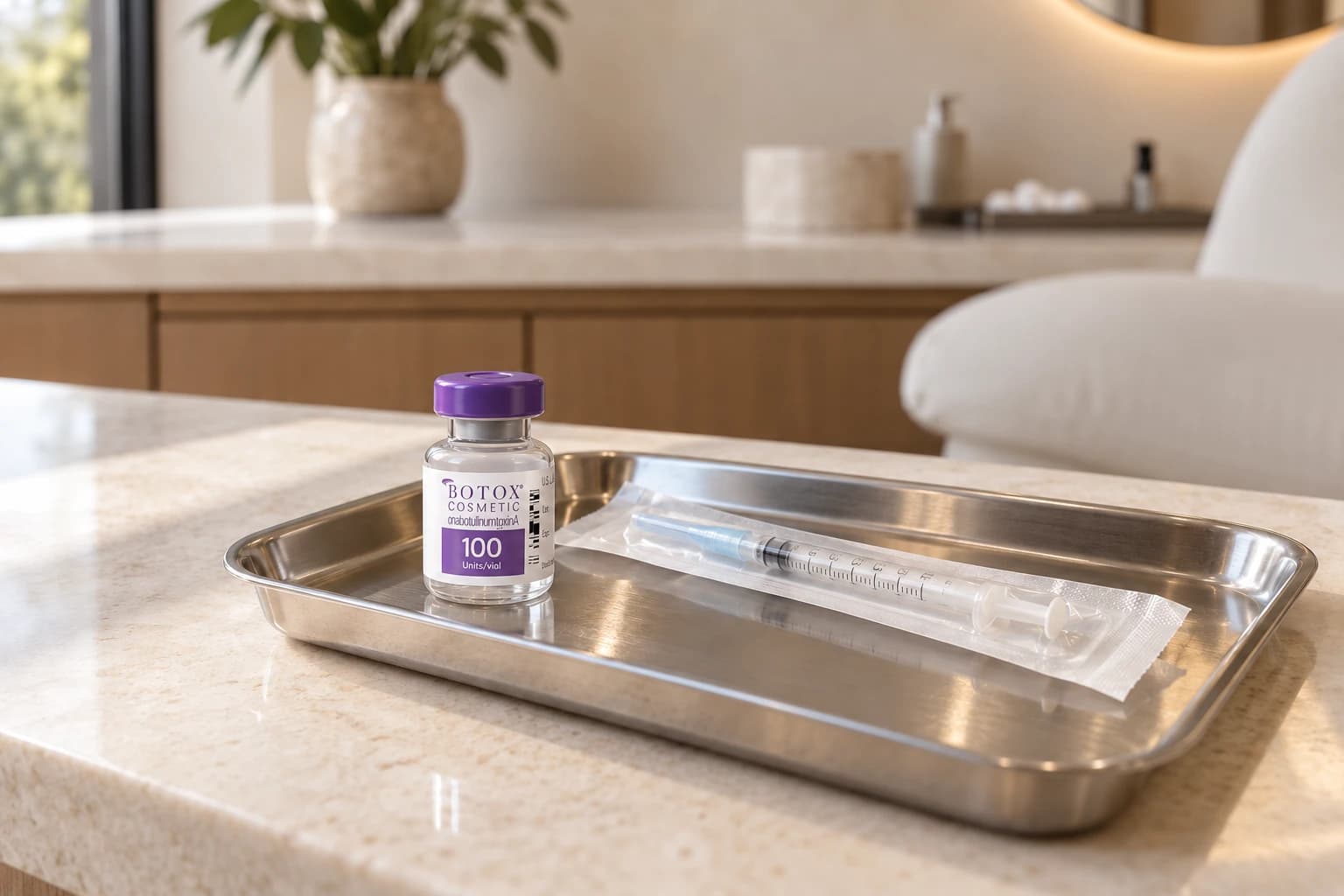
BOTOX® is a brand of onabotulinumtoxinA, a purified preparation of botulinum toxin type A. “Botulinum toxin” is the category; Botox is not the generic name for every brand.
When a clinician injects it at a specific site, it temporarily reduces the release of acetylcholine, a signal that activates muscles and some glands. It can therefore soften certain movement-related lines and treat some medical conditions. The indication, dose, and risks depend on the product, injection site, and patient.
information about Botox and Dysport treatment at Juvenalia Brío
Botox, BOTOX Cosmetic, and botulinum toxin
People often use “botox” to mean any neuromodulator, but that shortcut can cause errors.
- Botulinum toxin: a family of neurotoxins made by certain bacteria.
- OnabotulinumtoxinA: the established name of the active ingredient in BOTOX and BOTOX Cosmetic.
- BOTOX / BOTOX Cosmetic: brands with specific prescribing information and indications.
- Other products: for example, Dysport contains abobotulinumtoxinA, XEOMIN contains incobotulinumtoxinA, and MYOBLOC contains rimabotulinumtoxinB.
Sharing the word “toxin” does not make products interchangeable. FDA requires distinct established names, and the labels say potency units cannot be compared or converted.
Where does it come from?
The BOTOX label describes onabotulinumtoxinA as a sterile, vacuum-dried, purified botulinum toxin type A. It is produced by fermentation of the Hall strain of Clostridium botulinum type A and purified from the culture solution.
That does not mean bacteria are injected. The finished medicine contains purified protein, not live organisms. Foodborne or wound botulism and medical use of a purified, measured pharmaceutical product are very different situations.
Safety, however, cannot be explained only by saying the amount is “tiny.” It also depends on authentic authorized product, label-compliant storage and preparation, appropriate indication and dose, and sound injection technique.
What is in a BOTOX vial?
Formulation varies by vial size and should not be extrapolated to other brands.
According to the current U.S. therapeutic BOTOX prescribing information, a 100-Unit vial contains:
- 100 Units of botulinum toxin type A neurotoxin complex;
- 0.5 mg of human albumin;
- 0.9 mg of sodium chloride.
It is supplied sterile, vacuum-dried, and without a preservative. Before use, a clinician reconstitutes it with sterile preservative-free 0.9% sodium chloride according to the applicable label.
The label does not define the vial through a promise of “absolute purity,” and it does not mean another toxin has the same formulation. Patients also do not need a conversion from Units to nanograms to understand a clinical dose.
Why is albumin included?
Human albumin is part of the formulation as a stabilizer. The label explains that it is derived from human blood and describes donor-screening and manufacturing safeguards. Disclose any known allergy to a component before treatment.
How does Botox affect nerve signals?
The short explanation is that it temporarily reduces a nerve signal.
The prescribing information describes three main steps:
- toxin binds to receptor sites on motor or autonomic nerve endings;
- it enters the nerve ending;
- it inhibits acetylcholine release by cleaving SNAP-25, a protein needed to release that neurotransmitter.
When injected into muscle, it produces a localized reduction in muscle activity. When injected into the skin for hyperhidrosis, it temporarily reduces signaling to sweat glands in that area.
It does not erase a line already etched into skin or fill a hollow. Its main cosmetic effect is to temporarily reduce the muscle movement that creates certain dynamic lines.
Why does movement return?
The nerve ending is not permanently destroyed. Over time, transmission can recover and muscle function gradually returns. Duration varies by product, indication, area, and individual response.
For facial treatment, the AAD says many people notice change in 3 to 7 days and the effect generally lasts about 3 to 4 months, sometimes longer. Those times should not automatically be applied to migraine, hyperhidrosis, bladder, spasticity, or other indications.
What is it approved to treat?
There is no universal indication list for “botulinum toxin.” Each brand, presentation, and country has its own authorization.
Example: BOTOX Cosmetic in the United States
The current U.S. label includes temporary improvement in adults of:
- moderate-to-severe glabellar lines;
- lateral canthal lines;
- forehead lines;
- vertical platysma bands connecting the jaw and neck.
A commonly treated facial area does not automatically become approved. Lip flip, gummy smile, masseter treatment, perioral lines, and other applications should be described as off-label when they do not appear in the relevant label.
Example: therapeutic BOTOX in the United States
The label includes specific indications such as certain bladder disorders, prevention of headaches in adults with chronic migraine, spasticity, cervical dystonia, severe primary axillary hyperhidrosis inadequately managed with topical agents, and certain eye-muscle disorders.
For chronic migraine, the label definition is at least 15 headache days per month with headaches lasting at least 4 hours a day. It is not “31 or more days,” and treatment is preventive, not a cure or rescue medicine.
Off-label use
FDA explains that a clinician may use an approved drug for an unapproved use when medically appropriate. Off-label does not automatically mean illegal or proven; it means that agency has not evaluated and approved that product for that specific use.
Mexico: the exact brand and presentation matter
FDA approval describes the United States only. In Mexico, the COFEPRIS medicine registry and safety alerts should be checked for the exact brand, presentation, authorization holder, current status, and indication.
COFEPRIS has issued alerts about counterfeit BOTOX. Its June 2026 repository also warns that the presentation called BOTOX Cosmetic does not have an authorized Mexican registration. A familiar logo or foreign approval is not a substitute for Mexican verification.
Before treatment, you can ask to see:
- the product’s exact name and presentation;
- intact packaging, lot, and expiration date;
- current health registration;
- source and storage conditions.
Products bought through informal channels should not be used, and injections should not occur in homes, parties, or settings without appropriate medical conditions.
Differences between brands
The useful differences for a patient are simpler than a table of molecular sizes:
- each product has its own established active-ingredient name;
- each is manufactured and assayed by its own method;
- Units are not interchangeable;
- approved indications are not identical;
- preparation, storage, and dose must follow that product’s label;
- authorization and availability vary by country.
There is no official universal conversion such as “1 BOTOX Unit = 2.5–3 Dysport Units” or a universal 1:1 equivalence with XEOMIN. A brand also should not be promised to “spread more” or always be more precise based only on its name.
Selection should start with authentic authorized product, the specific indication, and the clinician’s training with that formulation.
Botox is not hyaluronic acid
| Botulinum toxin | Hyaluronic acid filler |
|---|---|
| Temporarily reduces a nerve signal and activity in the treated muscle | Adds volume or support in an anatomical plane |
| Used mainly for dynamic lines and some medical indications | Used for volume, contour, and selected lines or depressions |
| Does not fill a crease by itself | Does not block muscle contraction |
| Has its own risks, including spread of toxin effect | Has its own risks, including vascular occlusion |
Both may be used in some plans, but they are not substitutes and combining them is not automatically necessary.
Safety: what a patient should know
Adverse effects depend on the site and indication. They may include injection-site pain, swelling or bruising, headache, and weakness of a nearby muscle; facial treatment can cause eyelid drooping or asymmetry. “Local and temporary” does not describe every possible event.
Boxed warning
Every botulinum toxin product carries a warning about spread of effect. Symptoms can appear hours to weeks later and include generalized weakness, double vision, eyelid drooping, and trouble speaking, swallowing, or breathing. Swallowing or breathing problems can be fatal.
Seek urgent medical care for any of these symptoms.
Serious events are not limited exclusively to high therapeutic doses or untrained injectors. The label reports events in approved and unapproved uses, including at doses comparable to or lower than some therapeutic doses.
Contraindications and precautions
Formal BOTOX contraindications include allergy to a botulinum toxin preparation or formulation component and infection at the proposed injection site.
Neuromuscular disorders and existing swallowing or breathing problems may increase risk. Disclose aminoglycoside antibiotics, muscle relaxants, another botulinum toxin, and all medicines and supplements.
Data in pregnancy and breastfeeding are inadequate to define risk. An elective procedure should be discussed individually and is commonly postponed when there is no clear medical need.
Do not stop an anticoagulant, aspirin, or any prescribed medicine on your own.
Reducing avoidable risk
- Verify that the clinician is authorized and trained for the indication and anatomy being treated.
- Confirm the setting has appropriate conditions for medical care.
- Ask to see the product before reconstitution and check lot, expiration, and registration.
- Disclose medical conditions, allergies, prior toxin treatment, and every medicine you take.
- Ask whether the proposed use is approved or off-label in Mexico.
- Request a clear plan for side effects and urgent warning signs.
CDC and COFEPRIS have linked harm to counterfeit or mishandled products and injections performed in nonmedical settings. Product source is part of safety, not an administrative detail.
Sources
- AbbVie. BOTOX (onabotulinumtoxinA) Prescribing Information. https://www.rxabbvie.com/pdf/botox_pi.pdf
- AbbVie. BOTOX Cosmetic (onabotulinumtoxinA) Prescribing Information. https://www.rxabbvie.com/pdf/botox-cosmetic_pi.pdf
- U.S. Food and Drug Administration. BOTOX and BOTOX Cosmetic Prescribing Information. https://www.accessdata.fda.gov/drugsatfda_docs/label/2024/103000s5316s5319s5323s5326s5331lbl.pdf
- U.S. Food and Drug Administration. Understanding unapproved use of approved drugs. https://www.fda.gov/patients/learn-about-expanded-access-and-other-treatment-options/understanding-unapproved-use-approved-drugs-label
- MedlinePlus. OnabotulinumtoxinA injection. https://medlineplus.gov/druginfo/meds/a608013.html
- American Academy of Dermatology. Botulinum toxin therapy: overview. https://www.aad.org/public/cosmetic/wrinkles/botulinum-toxin-overview
- American Academy of Dermatology. Botulinum toxin therapy: FAQs. https://www.aad.org/public/cosmetic/wrinkles/botulinum-toxin-faqs
- Centers for Disease Control and Prevention. How to stay safe when getting botulinum toxin injections. https://www.cdc.gov/botulism/prevention/botulinum-toxin-injections.html
- Comisión Federal para la Protección contra Riesgos Sanitarios. Listados de Registros Sanitarios de Medicamentos. https://www.gob.mx/cofepris/documentos/registros-sanitarios-medicamentos
- Comisión Federal para la Protección contra Riesgos Sanitarios. Alertas sanitarias de medicamentos. https://www.gob.mx/cofepris/documentos/alertas-sanitarias-de-medicamentos
Reviewed by our medical team
Dra. Jessica Tapia
Medical Director
Clinical content on this blog is reviewed by the Juvenalia Brío medical team for scientific accuracy and consistency with the care we provide.