In brief
- A series of treatments is needed; there is no universal session count or guaranteed reduction.
- Laser hair removal can be performed on different skin tones, but the device and settings must be selected for each person.
- Coarse, dark hair usually responds better; white, gray, very light blonde, and red hair responds poorly.
- Disclose all medicines and supplements. Do not stop anticoagulants, aspirin, isotretinoin, or another medicine on your own.
- Because adequate pregnancy safety studies are lacking, this elective procedure is normally postponed.
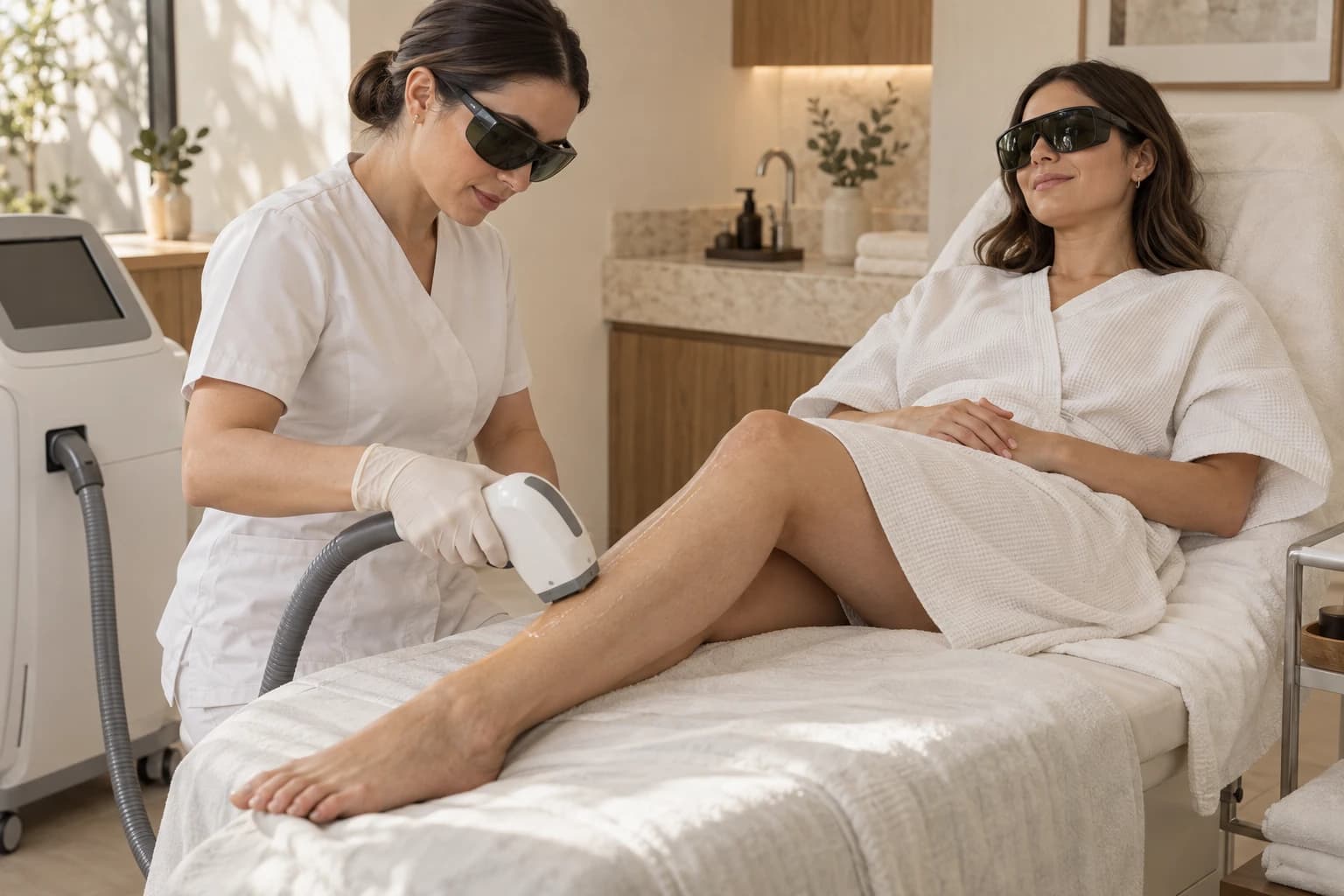
- Everyone in the room must wear appropriate eye protection.
- Redness, swelling, and discomfort can last from hours to a few days; burns, blisters, scarring, and permanent color change are less common but possible.
- A home device does not replace assessment and must be compatible with the user's skin tone and hair.
Laser Hair Removal: Safety, Preparation and Results
Laser hair removal can reduce hair growth for months or years, but it does not guarantee that hair is gone forever. Several sessions are needed because follicles do not all respond at once, and results vary with body area, hair color and thickness, skin tone, device, settings, and hormonal factors.
This guide follows the patient journey: how to prepare, what happens during a session, which risks matter, and what results are realistic. For a comparison of alexandrite, diode, Nd:YAG, multiwavelength devices, and IPL, see our guide to laser hair removal types.
information about laser hair removal at Juvenalia Brío
What it can achieve
The most honest goal is long-lasting reduction in hair growth. After a series, some people have no visible hair for months or years. Regrowth may be finer or lighter. Others need later sessions.
Some device clearances use the term “permanent hair reduction,” meaning stable, long-term reduction after a treatment course. It does not mean eliminating every follicle or preventing others from activating with hormonal change or time.
Avoid promises of:
- “80–90% guaranteed”;
- “six or eight sessions for everyone”;
- “final results in two or three months”;
- “one or two maintenance sessions every year for life.”
The number, interval, and degree of reduction should be adjusted to observed response.
How it works, in plain language
Light is absorbed by pigment in the hair and converted to heat. That heat damages structures in the follicle and reduces its ability to grow hair.
Treatment works best when the hair contains enough pigment. White, gray, very light blonde, and many red hairs therefore respond poorly. No cream or setting creates melanin where it is absent.
Follicles pass through different phases. Because they are not all susceptible at the same time, several sessions are needed. You do not need to memorize a percentage of hair in anagen: it varies by area and cannot calculate session count by itself.
Who may be a candidate
Assessment should consider:
- skin tone and recent tanning;
- hair color, thickness, and density;
- treatment area;
- medicines and supplements;
- scarring or keloid tendency;
- herpes or another infection;
- tattoos in the area;
- hormonal disorders;
- pregnancy or breastfeeding;
- expectations.
Laser hair removal is not performed on eyelids, eyebrows, or areas where energy could injure the eyes. Tattoos need careful boundaries because their pigment can absorb energy.
Brown or Black skin
Laser hair removal can be performed on different skin tones, but the device, settings, and cooling must be selected for each person. Dark or tanned skin has a higher risk of burns and pigment change.
Choose a professional with demonstrated experience treating your skin tone. Ask how many people with similar skin they have treated, which device they will use, how settings will be adjusted, and whether a small-area test is appropriate.
It is not accurate to say that every IPL or alexandrite system is “contraindicated” for dark skin or that any diode platform is automatically safe. Assessment belongs to the specific device and patient.
Light-colored hair
White, gray, very light blonde, and red hair often responds poorly because the laser needs pigment. Electrolysis may be an alternative for some people.
Fine facial hair: what needs assessment
Fine facial hair or “peach fuzz” should not be assumed suitable for laser simply because it is on the face. It should be distinguished from coarse, dark hair, with its color, thickness and distribution assessed alongside the skin. Ask which hair the treatment would target and what result is realistic for that area. The American Academy of Dermatology includes these features in the consultation.
Having a few coarse chin hairs does not, by itself, establish that treating fine cheek hair is appropriate. Assessment may lead to a different treatment boundary, an alternative or no procedure. Report recent changes in the pattern and the hair-removal methods you have used.
Hormonal hair growth
Polycystic ovary syndrome (PCOS), androgen changes, certain medicines, and other causes can promote new growth. Laser reduces existing hair but does not treat the underlying condition. The international guideline now uses the name polyendocrine metabolic ovarian syndrome (PMOS) for PCOS.
With PCOS, judge the response by more than whether every hair has disappeared. The international guideline supports considering professional laser or light treatment for facial hirsutism—excess coarse hair—and its effect on wellbeing, while rating the supporting evidence as very low certainty. It also notes that more sessions may be needed than for hirsutism without an identified hormonal cause; it does not give everyone the same course.
One 2005 randomized trial included 88 women with facial hirsutism attributed to PCOS. It compared five higher-energy laser treatments with five lower-energy treatments over six months. Self-reported weekly hair-removal time fell from 112 to 21 minutes in the higher-energy group, versus 92 to 56 minutes in the comparison group. The higher-energy group also reported greater improvement in perceived facial hair severity and psychological quality of life. These were questionnaire-based outcomes, not a percentage of follicles eliminated.
That six-month study does not establish lifelong clearance or a maintenance timetable. Nor is it a reason to request higher settings: this particular comparison does not determine which settings are appropriate for your skin and hair. Hair reduction and care for the underlying condition remain separate questions.
As practical preparation for a review, note changes in the same treated area, time spent removing hair, and any new symptoms or medication changes. These are discussion prompts, not a self-diagnosis or a clinic protocol. Seek assessment if growth appeared rapidly or is accompanied by irregular periods, voice change, scalp hair loss, or other symptoms. Do not assume all new growth is PCOS.
Two useful questions are:
- What change should we compare with my starting point, including the burden of removing hair?
- When would continuing or changing growth need medical reassessment rather than simply another session?
Adolescents and minimum age
There is no universal evidence-based age such as “15–16 for girls” or “16–18 for boys.” Puberty and hormonal change can make results less predictable.
For a minor, assessment should consider:
- reason for treatment and expectations;
- maturity to follow care instructions;
- a medical cause of growth;
- consent and local requirements;
- the possibility of more sessions as the hair pattern changes.
Individual consultation is more useful than a fixed age.
Pregnancy and breastfeeding
Because adequate pregnancy safety studies are lacking and hair growth may change, this elective procedure is normally postponed until after pregnancy. Saying that “the energy does not travel beyond the dermis” does not replace clinical evidence.
If you are breastfeeding, tell the clinician. The decision about when to resume should consider the area, hormonal changes, medicines, and clinic policy rather than one rule for everyone.
The consultation
A good consultation is more than choosing an area and buying a package. It should cover:
- skin history, healing, and herpes;
- medicines and supplements;
- tanning, self-tanner, and sun exposure;
- recent hair-removal methods;
- skin and hair assessment;
- goals and limits;
- exact device and why it is proposed;
- risks and alternatives;
- written instructions;
- a plan for a burn or reaction.
Ask for the device manufacturer and model and verify Mexican registration. U.S. FDA clearance or CE marking does not replace COFEPRIS status.
Medicines to disclose
Report every medicine and supplement, including:
- retinoids such as isotretinoin;
- medicines that increase light sensitivity;
- aspirin;
- anticoagulants;
- anti-inflammatory medicines;
- hormonal treatments;
- acne medicines;
- nonprescription and herbal products.
Do not stop a prescribed medicine on your own. The laser clinician and, when appropriate, the prescriber should decide whether to adjust or postpone treatment. Stopping an anticoagulant can have serious consequences; generic internet instructions cannot replace that decision.
Preparing for a session
Exact instructions depend on the device and person. Durable guidance is:
- do not tan or use self-tanner;
- use broad-spectrum sunscreen with SPF 30 or higher;
- do not remove hair by waxing, plucking, threading, or electrolysis during the advised period;
- shave only when instructed;
- report irritation, infection, wounds, or herpes;
- do not apply numbing cream on your own;
- arrive with the area clean as directed.
Timelines such as “12–24 hours,” “two to four weeks,” or “five to seven days” vary between sources and devices. If Juvenalia Brío gives you a calendar, it should be understood as that protocol's instructions, not a universal rule.
What happens during treatment
The clinician confirms the area, examines the skin, and sets the device. Then:
- The skin is cleaned and, when appropriate, shaved.
- Tattoos, lesions, and risk areas are covered or avoided.
- Everyone in the room wears eye protection appropriate for that laser or light source.
- Contact cooling, air, gel, or spray may be used.
- Pulses or passes are delivered according to the device protocol.
- The skin response is checked before the session ends.
Sensation ranges from warmth to stinging or a rubber-band snap. Area, hair thickness, settings, and personal sensitivity matter. Someone else's description as “less painful than waxing” does not predict your experience.
If a numbing product is considered, it should be provided or recommended by the treating clinician; an excessive layer or a large area can be dangerous.
After treatment
Common effects include:
- redness;
- swelling around follicles;
- warmth or discomfort.
They can last from hours to one to three days. Follow written instructions for cooling, washing, moisturizing, and sun protection.
In general:
- avoid sun and tanning;
- use broad-spectrum sunscreen with SPF 30 or higher;
- do not scrub, scratch, or exfoliate irritated skin;
- wait for guidance before intense exercise, swimming, sauna, active products, or exfoliation.
Schedules such as “24–48 hours” or “day 5–7” should be presented as service instructions for that device and reaction, not universal facts.
Treated hairs do not always fall out immediately; they may shed over days or weeks. Do not pluck them to “speed up” the process.
Risks and when to ask for help
Common effects are usually temporary. Less common complications include:
- blisters and burns;
- crusting;
- infection;
- scarring;
- light or dark marks, sometimes permanent;
- herpes reactivation;
- eye injury;
- paradoxical hair growth around the area.
Rarely, hair may increase around the treated area. If this occurs, pause the protocol and request reassessment; management depends on the area, settings, and possible hormonal factors. More sessions should not be promised as the fix.
Contact the service promptly for blistering, severe or worsening pain, spreading redness, drainage, skin loss, progressive color change, or eye symptoms. Seek urgent care for eye injury or vision loss.
When hair seems to increase: paradoxical hypertrichosis
Paradoxical hypertrichosis describes an unexpected increase in hair in or around the treated area after laser or light-based hair removal. It does not simply mean that some hair returns. A 2024 clinical study assessed increases against the pretreatment baseline and excluded other known causes; a doctor made the final diagnosis.
Shedding of treated hair over days or weeks and later regrowth—often finer—are different phenomena, described by Mayo Clinic. If you notice more hair, thicker hair or growth extending beyond the original pattern, request the reassessment described in the risks section. Bring treatment dates, the device name if known and any available earlier photographs. Comparison with the original pattern, examination and history help establish what changed; one photograph alone does not establish the cause or determine whether more sessions are appropriate.
Ingrown hairs
Hair reduction may help some people with pseudofolliculitis or ingrown hairs by reducing shaving and the number of hairs. It does not “remove the root cause” in every case. Inflammation, infection, shaving technique, and other conditions may need separate assessment and treatment.
Home devices
Some home devices use pulsed light, and some are authorized in certain markets. They do not replace professional assessment and usually require repeated use and maintenance.
Before using one:
- verify registration or authorization for your country;
- confirm suitability for your skin tone and hair color;
- follow exclusions for tattoos, moles, genitals, and eyes;
- use the specified protection;
- do not exceed the instructions;
- stop if it causes a burn, blister, or pigment change.
In Mexico, check COFEPRIS first. “FDA-approved” does not by itself establish that the same model is locally authorized.
Choosing a provider
Ask:
- Who assesses my skin and who operates the device?
- What training and experience do they have with my skin tone?
- What are the manufacturer, model, and registration number?
- What eye protection is used?
- How are settings selected?
- Are settings and skin response documented?
- Who responds if I develop a burn after hours?
- Can the package be adjusted if my response changes?
Be cautious with guaranteed outcomes, rigid countdowns, packages that do not allow reassessment, and “zero risk” claims.
Sources
- American Academy of Dermatology. Laser hair removal: FAQs. https://www.aad.org/public/cosmetic/hair-removal/laser-hair-removal-faqs
- American Academy of Dermatology. Laser hair removal: Preparation. https://www.aad.org/public/cosmetic/hair-removal/laser-hair-removal-preparation
- Mayo Clinic. Laser hair removal. https://www.mayoclinic.org/tests-procedures/laser-hair-removal/about/pac-20394555
- Cleveland Clinic. Laser Hair Removal. https://my.clevelandclinic.org/health/treatments/21757-laser-hair-removal
- American Society for Laser Medicine and Surgery. Laser Hair Removal. https://www.aslms.org/topic/laser-hair-removal/
- American Society for Dermatologic Surgery. Hair Removal. https://www.asds.net/skin-experts/skin-conditions/hair-removal/quot
- U.S. Food and Drug Administration. Frequently Asked Questions About Lasers. https://www.fda.gov/radiation-emitting-products/laser-products-and-instruments/frequently-asked-questions-about-lasers
- NHS. Anticoagulant medicines. https://www.nhs.uk/medicines/anticoagulants/
- COFEPRIS. Medical device registration records. https://www.gob.mx/cofepris/documentos/registros-dispositivos-medicos
Reviewed by our medical team
Dra. Jessica Tapia
Medical Director
Clinical content on this blog is reviewed by the Juvenalia Brío medical team for scientific accuracy and consistency with the care we provide.