In brief
- A facial peel is a controlled chemical exfoliation that removes damaged skin layers and stimulates cell regeneration.
- They are classified as superficial, medium and deep according to the skin layer they reach.
- The acid, its concentration and contact time determine the depth and results.
- Superficial peels require virtually no recovery; deep ones require strict medical supervision.
- Not everyone is a candidate: active infections prevent treatment of the area, while pregnancy, breastfeeding, and current or previous isotretinoin use require individual professional assessment.
Facial peeling: what it is, how it works and what types exist
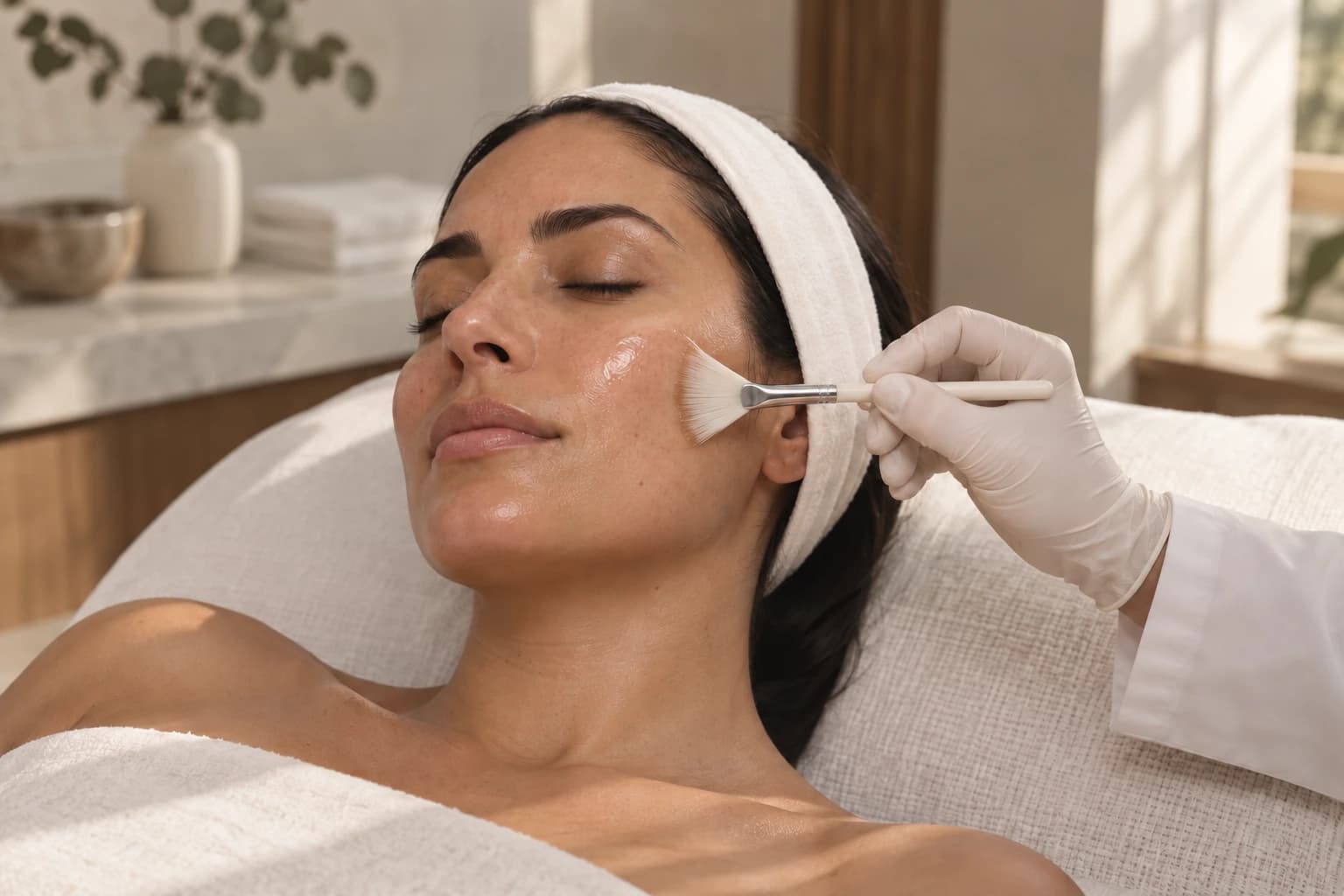
A facial peel is a dermoesthetic procedure that applies a chemical solution to facial skin to produce controlled exfoliation. The acid dissolves the bonds between cells in the stratum corneum—the outermost layer of the epidermis—causing damaged layers to shed and activating the skin's natural repair response: increased production of collagen, elastin and new cells. The result is skin that is more uniform, radiant and with fewer imperfections.
Unlike cosmetic exfoliation, which works only on the surface, a medical peel can reach different depths of skin depending on the acid used, its concentration and the exposure time.
How a facial peel works
The applied acid breaks the intercellular bonds (desmosomes) of the stratum corneum, causing a controlled injury. The body interprets this injury as a signal to accelerate cell renewal: damaged superficial layers shed and are replaced by new skin, while in deeper layers, collagen and elastin synthesis is activated.
The process follows three phases:
- Application and penetration. The professional applies the solution to clean, degreased skin. The depth of penetration depends on the type of acid, its pH, concentration and the number of layers applied.
- Neutralization or removal. Some acids (such as glycolic) require neutralization with sodium bicarbonate or water; others (such as salicylic) are self-limiting and are simply removed with water.
- Regeneration phase. In the following days, the skin begins the process of peeling and reconstruction. Duration varies from hours (superficial peels) to weeks (deep peels).
Types of peeling by depth
Superficial peel
Acts exclusively on the epidermis. Uses alpha-hydroxy acids (AHA) such as glycolic or lactic acid, or beta-hydroxy acids (BHA) such as salicylic, in low to moderate concentrations. Improves texture, uneven tone, mild acne and fine lines. Recovery is minimal: mild redness that disappears in 1-3 days. Suitable for most skin types, including dark skin with proper preparation.
Medium peel
Penetrates beyond the epidermis to the papillary dermis (the upper portion of the dermis). The most common agent is trichloroacetic acid (TCA) at 15-35%, alone or in combination (TCA + Jessner solution, TCA + 70% glycolic acid). Treats fine to moderate wrinkles, superficial acne scars, solar dyschromia and resistant melasma. Recovery lasts 7-14 days with visible peeling, redness and hypersensitivity.
Deep peel
Reaches the reticular dermis. Performed with phenol (Baker-Gordon formula) and requires cardiac monitoring, sedation or anesthesia. Treats deep wrinkles, severe photoaging and marked scars. Recovery is prolonged (2-4 weeks of intense peeling) and the risk of complications—permanent hypopigmentation, scars, cardiac toxicity—is significantly higher. It is contraindicated in skin types IV-VI due to the high risk of dyschromia.
Comparison of acids used in facial peeling
| Acid | Type | Usual depth | Main indications | Approximate recovery |
|---|---|---|---|---|
| Glycolic | AHA | Superficial to medium (depending on concentration: 30-70%) | Uneven texture, fine lines, mild hyperpigmentation, early photoaging | 1-3 days (superficial); 7-14 days (medium, combined with TCA) |
| Salicylic | BHA | Superficial (20-30%) | Active acne, oily skin, enlarged pores, comedones | 1-3 days; fine peeling |
| Lactic | AHA | Superficial (up to 30%) | Sensitive skin, dehydration, mild hyperpigmentation | 1-2 days; minimal redness |
| Mandelic | AHA | Superficial | Acne, hyperpigmentation in dark skin, mild rosacea | 1-2 days; very well tolerated |
| TCA | — | Medium (15-35%) | Moderate wrinkles, acne scars, solar lentigines, melasma | 7-14 days; marked peeling |
| Jessner | Combined (salicylic + lactic + resorcinol) | Superficial to medium | Acne, hyperpigmentation, photoaging, preparation for TCA | 3-7 days depending on layers applied |
| Retinoic | Retinoid (vitamin A acid) | Superficial to medium (depending on concentration) | Acne, photoaging, pre-peel preparation, collagen stimulation | 3-7 days; marked peeling and photosensitivity |
| Phenol | — | Deep (Baker-Gordon formula) | Deep wrinkles, severe photoaging, marked scars | 2-4 weeks; requires medical supervision |
Mandelic acid deserves special mention: its molecule is larger than glycolic acid, which allows it to penetrate more slowly and with less irritation. This makes it an excellent option for sensitive skin and dark skin types (IV-VI), where the risk of postinflammatory hyperpigmentation is greater.
What to expect during a facial peel
Before the procedure. The professional evaluates skin type, conditions to be treated and clinical history. Your provider may ask you to temporarily stop retinoids or other active products and, in some cases, recommend pretreatment with a pigment-reducing agent. The plan and timing depend on the peel and your skin; follow the specific instructions you receive.
During application. The skin is cleansed and the acid is applied with gauze, brush or cotton. The sensation varies depending on depth: a superficial peel produces mild tingling or burning that lasts minutes; a medium peel generates more intense heat sensation; a deep peel requires anesthesia. Duration depends on the depth and treatment area: superficial and medium peels are generally shorter, while a full-face deep peel may take about 90 minutes.
After the procedure. With superficial peels, skin may appear slightly pink and begin to peel subtly the next day. With medium peels, peeling usually starts between day 2 and 4, with visible sheets peeling off over 7-14 days. With deep peels, skin forms crusts and the healing process can extend several weeks. In all cases, strict sun protection (SPF 30+ minimum) is mandatory during and after recovery.
For more detail on recovery, risks, and aftercare by depth, see our guide to peel types, recovery, risks, and care.
Who is a facial peel suitable for
A facial peel can benefit people with:
- Uneven texture or dull skin
- Fine lines and superficial wrinkles
- Hyperpigmentation, sun spots or melasma
- Mild to moderate active acne or superficial acne scars
- Photoaging (accumulated sun damage)
- Actinic keratosis (premalignant lesions, treated with medium or deep peel under medical supervision)
The type of peel and recommended acid depend on individual diagnosis. Superficial peels may be repeated approximately every 2-5 weeks when recommended. The interval between medium peels should be individualized; a full-face deep peel is generally performed only once.
If an assessment indicates that a superficial protocol fits your goal, see information about Lunch Peel at Juvenalia Brío.
Who should avoid a facial peel
There are absolute and relative contraindications:
Situations that require professional assessment or prevent the procedure at that time:
- Active infection in the area to be treated (active cold sores, bacterial or fungal infections)
- Current or previous isotretinoin use (tell your provider; whether and when to proceed with a peel should be decided individually)
- Pregnancy or breastfeeding (consult your obstetrician and treating provider; the recommendation depends on the agent, concentration and peel depth)
- Open wounds or compromised skin barrier
- Known allergy to any component of the solution
Relative contraindications (require caution and adaptation):
- Skin types IV-VI: superficial and some medium peels are safe with proper preparation. Deep phenol peels are contraindicated due to the high risk of hypopigmentation and hyperpigmentation.
- Recent use of topical retinoids (tell your provider and stop them only for the period you are instructed to)
- Recent sunburn
- History of abnormal scarring (keloids, hypertrophic scars)
- Use of photosensitizing medications (doxycycline, certain chemotherapy agents)
- Autoimmune diseases or immunosuppression
The professional evaluates each case to select the safest acid, concentration and protocol.
Chemical peel vs microneedling: how to compare them
The useful comparison starts with the concern being treated and the procedure proposed. A superficial peel, a deep peel and radiofrequency microneedling involve different depths, risks and recovery. “Best for texture” is too broad to decide between them.
Chemical peels use a chemical solution to treat selected skin layers. Conventional microneedling creates small punctures and stimulates collagen production. Both can be considered for some concerns, but they are not interchangeable. AAD peel overview, AAD microneedling guidance.
| What you want to address | Useful distinction | What to clarify |
|---|---|---|
| Flat marks or uneven color | Pigmentation and a depressed scar are different findings. Peels can address some discoloration; selection depends on its cause. | What is causing the color change, and could the proposed procedure aggravate it? |
| Indented acne scars | Microneedling is used for acne scars, while scar pattern and depth affect treatment selection. | Which part of the scar pattern is the treatment intended to improve? |
| Painful, inflamed breakouts | Treating active acne is a different task from treating its residual scars. | Does the active condition need treatment before a procedure? |
| Fine lines or rough texture | Procedure depth and the specific device or peel matter as much as the category name. | What improvement is realistic, and what recovery does that plan involve? |
The AAD advises delaying microneedling when there is a skin infection or painful, deep or pus-filled acne. A comparison should establish that starting point before discussing a series of sessions. AAD candidacy guidance.
Compare recovery and pigment risk
Peel recovery changes substantially with depth. A medium or deep peel cannot be represented by the recovery of a light peel. Use the specific plan to discuss wound care, sun exposure, makeup and follow-up. AAD peel guidance.
Microneedling can also cause redness, discomfort and pigment changes. Experience treating your skin tone matters for either procedure. Although the AAD describes microneedling across skin tones, the FDA notes that some authorized devices were not studied in darker skin types. Ask about the actual device and relevant experience rather than assuming either option has no pigmentation risk. FDA microneedling information.
Establish whether radiofrequency is part of the proposal
Radiofrequency microneedling adds heat and needs its own discussion. In October 2025, the FDA warned of reported serious complications with certain uses, including burns, scarring, fat loss and nerve damage. That warning concerns RF procedures; it should not be used as a description of every conventional microneedling treatment. FDA RF safety communication.
Bring your history of pigment changes, unusual scarring, recent procedures and medication use. Ask why the proposed option fits the concern, what would lead the clinician to postpone it, and how improvement will be reviewed. If several procedures are proposed, each should have a clear purpose and sequence; combining them is not automatically preferable.
For the existing local treatment information, see facial microneedling at Juvenalia Brío. The exact device and treatment plan need to be confirmed during assessment.
Sources
- Mayo Clinic — Chemical peel
- American Academy of Dermatology — Chemical peels: Overview
- American Academy of Dermatology — Chemical peels: FAQs
- American Academy of Dermatology — Chemical peels: Preparation
- Cleveland Clinic — Chemical Peels
- FDA — Warning about chemical peel products without professional supervision
- American Academy of Dermatology — How to apply sunscreen
- American Academy of Dermatology — Microneedling
Reviewed by our medical team
Dra. Jessica Tapia
Medical Director
Clinical content on this blog is reviewed by the Juvenalia Brío medical team for scientific accuracy and consistency with the care we provide.