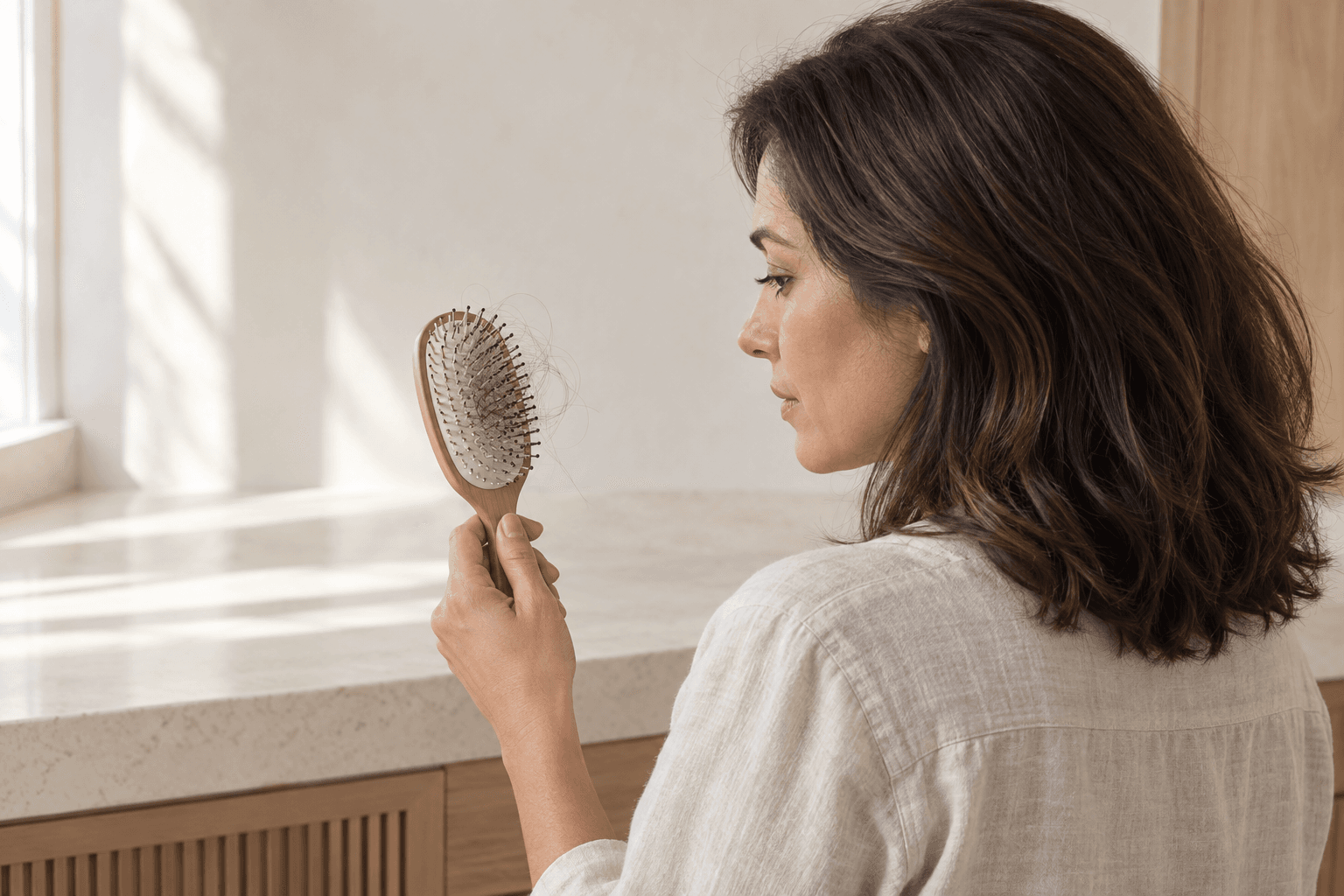
Hair shedding describes hairs falling out; some shedding is part of the normal hair cycle. Hair loss is a broader term for a reduction in hair, which can result from excessive shedding, changes in growth or damage. Breakage means the hair shaft has snapped. These descriptions can overlap, so finding more hair in your brush does not, by itself, tell you the cause or whether the change will be temporary. DermNet: hair loss
The useful starting point is to describe what has changed, where you notice it and when it began. You do not need to decide which diagnosis fits before asking for help.
Shedding, breakage and thinning: what do the words describe?
People often use “hair loss” to mean anything from loose hairs after washing to a gradually widening part. Being more specific helps explain the concern.
| Term | What it describes | What it does not establish | Useful detail to note |
|---|---|---|---|
| Shedding | Hairs coming away from the scalp, noticed during washing, brushing or daily life | Whether the amount is normal for you or what caused an increase | A change from your usual pattern and when you first noticed it |
| Breakage | Hair shafts snapping rather than remaining intact | Why the hair is fragile, or whether shedding is also occurring | Changes in heat styling, chemical processing, brushing or tight hairstyles |
| Thinning | Less fullness or more visible scalp, such as a widening part | A single cause, or whether it is temporary or permanent | Where the change appears and whether it is progressing |
Excessive shedding can itself cause thinning. Hair damage can also contribute to a loss of fullness. These are reasons to consider the whole history rather than sorting a few hairs into a diagnosis. DermNet: hair shedding, AAD: hair damage
How much shedding is normal?
Some daily shedding is expected. The American Academy of Dermatology gives an approximate range of 50–100 hairs a day; Cleveland Clinic's patient guidance uses 50–150. These are general estimates, not a reliable pass-or-fail test for an individual. A new change in fullness, pattern or scalp symptoms deserves attention even if you have not counted many hairs. AAD: shedding, Cleveland Clinic: expected shedding
What you see on a wash day also depends on your routine. Washing can release hairs that were already ready to shed, and people who wash less often may notice more accumulated loose hair at once. A single shower therefore does not provide a dependable daily total. Note whether your routine changed along with the amount you noticed; you do not need to collect every strand before an appointment. Cleveland Clinic: shower shedding
What changed, and when?
Start with the first change you remember: more loose hair, a different hairline, a widening part, shorter broken hairs or discomfort. Then look back over the preceding months.
Illness with fever, surgery, childbirth, significant weight or dietary changes, substantial stress and medication changes can be relevant to a shedding history. They are clues to discuss, not proof of the cause. In one common form of increased shedding, telogen effluvium, the visible change may follow an earlier event by a few months. Cleveland Clinic: telogen effluvium
Also note your usual hairstyles and any recent bleaching, straightening, extensions or frequent heat styling. These can matter when a professional considers hair damage or traction. AAD: hair-care practices
Bring the names and approximate start dates of medicines and supplements. If you suspect a prescribed medicine is involved, discuss it with the prescriber; do not stop it on your own. AAD: medication-related concerns
How long can increased shedding last?
There is no single duration that applies to every change. Some episodes related to a temporary disruption settle gradually, while shedding can also persist. A timeline helps a professional assess possible explanations; it does not predict a recovery date. Cleveland Clinic: temporary and persistent shedding
Shedding and another cause of hair loss can occur together. For example, an episode of increased shedding does not rule out underlying pattern hair loss. The assessment may therefore need to explain both the loose hairs and a longer-term change in density. AAD: finding the cause
Do not use an online “regrowth timeline” as a reason to postpone assessment of a new bald patch or a progressing change. A useful follow-up plan specifies what to watch and when to return, based on the explanation that best fits your history and examination.
When is an assessment useful?
Arrange an assessment if shedding is noticeably different from your usual pattern, thinning is progressing, your part or hairline is changing, or a bald patch develops. Hair changes can also affect eyebrows or other body areas; mention those changes too. AAD: signs of hair loss
Seek prompt medical advice for sudden substantial hair loss or a rapidly appearing bald patch. Tell the clinician if the change comes with pain, burning, marked itching, scaling, redness or sores. Those details can point to a scalp problem that needs examination. You can also ask for an assessment simply because the change is worrying you; you do not need to wait for a large area of visible loss. Cleveland Clinic: when to seek help, AAD: associated symptoms
Your hair-change timeline
Use this short worksheet to organize observations before an appointment. Approximate dates are enough; leave a field blank if you are unsure.
What changed
- The change I noticed: ____________________
- Where I notice it: ____________________
- Any scalp symptoms or changes elsewhere: ____________________
When it changed
Earlier events → First noticed → Changes since then
- Earlier date or period, and what happened: ____________________
- When I first noticed the hair change: ____________________
- Since then, it has stayed similar, improved, progressed or fluctuated: ____________________
What else was happening
- Health, stress, dietary or weight changes I want to mention: ____________________
- Medicines or supplements, with approximate dates: ____________________
- Hair-care or styling changes: ____________________
- My main question or concern: ____________________
The worksheet is a memory aid. Recording an event next to a hair change does not mean that the event caused it.
What to bring and ask
Bring your timeline and medication list, along with relevant previous assessment results if you have them. A dermatologist may ask about onset and examine the scalp and hair. Further tests depend on what the history and examination suggest; not everyone needs blood tests or a scalp biopsy. AAD: diagnosis
Useful questions include:
- What best explains the changes I have described?
- Could more than one process be involved?
- Is more information or testing needed, and what would it change?
- Is observation reasonable, or is treatment recommended for the suspected cause?
- What should I watch for, and when should I follow up?
Understanding the cause comes before choosing a product or procedure. Leave the appointment with an explanation of what is known, what remains uncertain and the next step that fits your situation.
Reviewed by our medical team
Dra. Jessica Tapia
Medical Director
Clinical content on this blog is reviewed by the Juvenalia Brío medical team for scientific accuracy and consistency with the care we provide.