In brief
- Hydrafacial is device-assisted hydradermabrasion or exfoliation, not a medical category that replaces dermatologic diagnosis.
- The model matters. Syndeo, Elite, Allegro, and other systems may have different instructions and contraindications.
- Many people return to activities promptly, but redness, tightness, or irritation can last for hours and, under the current Syndeo Medical instructions, up to 72 hours.
- It is not automatically appropriate for rosacea, sensitive skin, or active acne.
- The instructions reviewed say it has not been adequately evaluated during pregnancy, breastfeeding, or in children.
- Published evidence is small and does not support universal percentages for wrinkle, pigment, sebum, or acne reduction.
- Boosters are applied at the surface; “deep penetration,” cellular regeneration, or proven collagen production should not be promised without evidence for the exact product.
- Frequency, preparation, makeup, and combinations with other procedures should follow the model instructions and clinical assessment.
Hydrafacial: how it works, evidence, safety, and aftercare
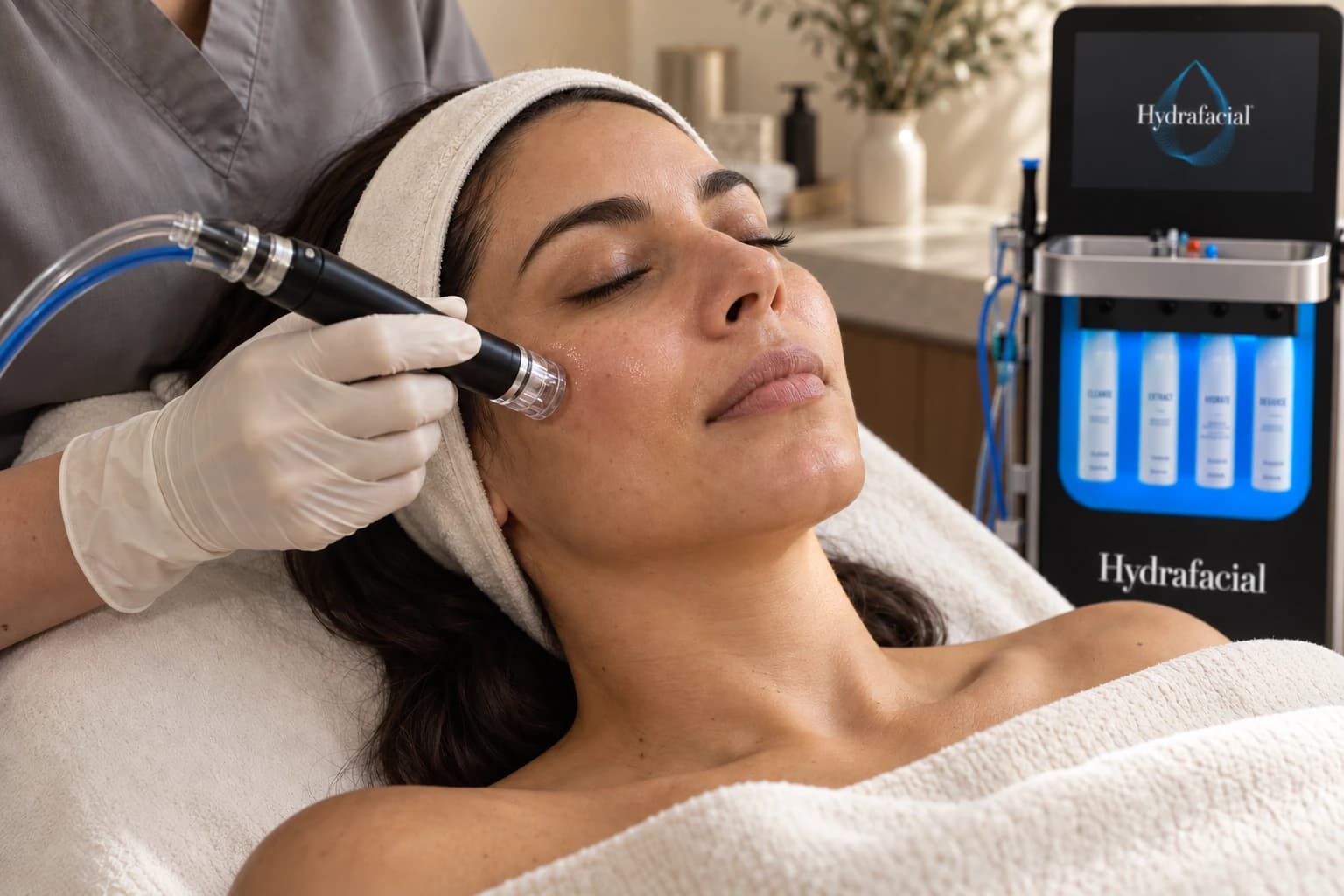
Hydrafacial is a branded treatment that uses a device to exfoliate surface layers, apply suction, and distribute solutions over the skin. The company calls its technology Vortex-Fusion and organizes the protocol into three steps: Cleanse + Peel, Extract + Hydrate, and Fuse + Protect.
It may temporarily improve the appearance of texture, radiance, and hydration for some people. It should not be presented as a universal medical treatment that is painless, irritation-free, or suitable for every skin type. Safety depends on the exact model, tips and solutions, settings, skin condition, and operator training.
information about Hydrafacial treatment at Juvenalia Brío. See the Hydrafacial pricing menu.
How does it work?
The handpiece and tips combine exfoliation, liquid flow, and suction. Intensity and solution change with the protocol.
1. Cleanse + Peel
This removes surface material and may use exfoliating solutions. “Peel” does not mean it is equivalent to a medical chemical peel. Acid type and concentration should be confirmed because they change tolerability and risk.
2. Extract + Hydrate
Suction helps remove surface material and contents from some pores while the device distributes a solution. It does not guarantee that every pore is cleared or prevent acne by itself.
3. Fuse + Protect
This applies solutions or boosters over the skin. The company describes cosmetic benefits such as a smoother or more hydrated appearance. The treatment has not shown that every peptide, antioxidant, or growth factor reaches the dermis or produces new collagen.
The phrase “infusion at the moment of maximum receptivity” is marketing language, not proof of clinically meaningful deep absorption.
Model and solutions matter
Hydrafacial markets different devices and protocols. Before treatment, ask:
- which model will be used;
- which tip and solutions will be applied;
- what ingredients they contain;
- whether the tip will be new and single-use;
- what the current instructions list as contraindications;
- whether the device and supplies have the required Mexican authorization;
- what to do if a reaction occurs.
You can also look up Juvenalia Brío in Hydrafacial México’s published provider directory in Spanish. Before treatment, ask which device, solutions, and protocol will be used for your session.
The current Syndeo Medical instructions require a clean, unused tip for each treatment and warn that reuse can cause infection. It is not necessary to claim that “three tips per session guarantee hygiene”; the important requirement is following the exact system and not reusing consumables.
Hydrafacial vs DiamondGlow: what actually differs?
Hydrafacial and DiamondGlow are different branded systems, not two names for the same facial. Both combine surface exfoliation, suction and the application of topical products; the important differences are the tip, the solutions and how the treatment is adjusted—not a proven universal winner.
| What to compare | Hydrafacial | DiamondGlow |
|---|---|---|
| Surface action | Liquid flow and suction through a treatment tip; the protocol can also include an exfoliating peel. | A diamond tip provides physical abrasion alongside suction and serum application. |
| Products used | Solutions and optional boosters selected for the Hydrafacial system and protocol. | SkinMedica Pro-Infusion Serums paired with the DiamondGlow device. |
| Adjustable elements | Tip selection, vacuum, handpiece pressure and the chosen solutions, within the model's instructions. | Degree of tip abrasion, vacuum setting and serum selection, within the device's instructions. |
These are manufacturer-described features, not comparative outcome measurements: Hydrafacial treatment description, DiamondGlow treatment description and DiamondGlow customization.
Calling the choice simply “chemical versus mechanical” misses part of the picture. Hydrafacial also uses tips for exfoliation, while the entire DiamondGlow treatment includes topical formulations. Neither a diamond tip nor a branded fluid-delivery mechanism tells you, by itself, which treatment will be more comfortable or more useful for your skin.
What the products and studies do—and do not—tell you
The U.S. DiamondGlow information describes its SkinMedica Pro-Infusion Serums as cosmetics, not medicines intended to treat disease, and states that they are not FDA-approved. That statement concerns the serums; it should not be confused with the device's regulatory status. Nor does U.S. product information establish authorization or availability in Mexico. See the manufacturer's use, safety and cosmetic-serum information.
A 2023 DiamondGlow clinical study reported improvements in several appearance measures, but evaluated six treatments together with a tailored home-skincare regimen. Sixteen participants completed the study. It was open-label, had no control group, and was sponsored by Allergan Aesthetics; its authors were AbbVie employees. It did not compare DiamondGlow with Hydrafacial or isolate the device's contribution from the products used alongside it.
That distinction matters when reading photographs, satisfaction percentages or “long-lasting” claims. Evidence for a combined regimen is not evidence that one machine is better, that a particular serum reaches a useful depth, or that your skin will respond in the same way. The Hydrafacial studies discussed below also need to be read in the context of their specific protocols.
Three questions that make the comparison useful
- What exactly would be used? Identify the device model, tip and named solutions. Ask which ingredients and settings matter for your skin, rather than choosing from a brand name alone.
- Is exfoliation appropriate today? The Syndeo Medical instructions, revision March 4, 2026, restrict treatment to intact skin and list specific exclusions. DiamondGlow likewise warns against treating compromised skin. An adjustable treatment is not automatically suitable during irritation or an active skin problem. Use the applicable Hydrafacial instructions and the DiamondGlow safety information above.
- What would count as a worthwhile result? Discuss the particular concern, how improvement would be assessed, possible reactions and when to reassess. A visible short-term change and a durable improvement are different outcomes; choosing neither treatment can also be reasonable.
For the broader distinction between surface methods, see our guide to physical and chemical exfoliation.
What results are realistic?
Some people may notice temporarily smoother, more radiant, or more hydrated-looking skin after surface material is removed and products are applied. Magnitude and duration vary.
There is no strong support for promising:
- a 45% reduction in wrinkle depth;
- 80% improvement in texture or elasticity;
- 70% more hydration for 12 weeks;
- 30% less hyperpigmentation;
- 50% greater moisture retention;
- peak results lasting five to seven days in every patient.
Immediate visual changes may also reflect moisturization, surface cleansing, and temporary redness. They do not prove deep repair, collagen production, or permanent cumulative benefit.
What does the evidence show?
Available literature is limited, and several studies are small or have conflicts of interest.
2008 hydradermabrasion study
A Freedman study included 20 women and six treatments. It reported clinical and histologic improvements in fine lines, pore size, and hyperpigmentation. Its size, design, and age limit extrapolation to every device, booster, and patient. The public abstract does not support the 45% and 80% figures previously stated in this article.
2022 acne study
Storgard and colleagues studied 20 people over 12 weeks in an open-label, uncontrolled design. Participants received six Clarifying treatments every two weeks, including blue LED. The proportion rated clear or almost clear by investigators rose from 20% to 65%. One author was a Hydrafacial employee.
This does not show that any Hydrafacial alone has a 65% success rate, does not separate the LED effect, and does not support treatment of severe or nodulocystic acne.
2024 imaging study
The actual Razi study included eight volunteers and used LC-OCT imaging. It was not a 50-person acne study reporting 65% less acne and 35% less sebum. It also found no visible difference in collagen quantity or quality at two weeks. The numbers previously attributed to that paper were incorrect and have been removed.
Who should avoid or postpone treatment?
The exact model instructions take priority. The Syndeo Medical instructions reviewed say not to treat compromised skin or an active condition in the area, including:
- wounds, open lesions, or infection;
- active herpes;
- sunburn or recent injury;
- active eczema, dermatitis, psoriasis, or rash;
- active or inflammatory acne;
- fragile or very irritated skin;
- a suspicious lesion that has not been assessed;
- allergy to a solution ingredient.
They also say the system has not been evaluated in children, pregnancy, or breastfeeding. This does not mean every circumstance carries the same risk; it means safety should not be promised without assessment.
Medical guidance is needed for autoimmune disorders, cancer, vascular disease or significant telangiectasia, medicines that thin skin, chemotherapy, immunosuppressants, anticoagulants, prolonged corticosteroid use, and other factors listed in the applicable instructions.
Disclose all medicines and recent procedures, including isotretinoin. Do not stop prescribed medicine on your own.
Rosacea and sensitive skin
Hydrafacial should not be described as safe for every person with rosacea or as especially suitable for papulopustular rosacea.
The AAD explains that rosacea often makes skin sensitive and easily irritated and advises stopping exfoliation when it causes irritation. The Syndeo instructions treat rosacea as a sensitive-skin warning requiring a test, lower pressure or suction, and appropriate solution—not as a universal indication.
If there is a flare, pustules, burning, open skin, or active inflammation, postpone cosmetic treatment and follow the dermatologist’s plan. See also our rosacea guide.
Acne
Hydrafacial does not replace medical acne treatment. The current Syndeo Medical instructions also say not to treat active or inflammatory acne.
The small open-label study described above evaluated a specific mild-to-moderate acne protocol that included blue LED. It should not be extrapolated to another model, solution, or patient. Painful, nodular, scarring, or infected acne needs dermatologic assessment.
Does it hurt? Is there downtime?
The sensation is often described as suction, coolness, pressure, or tingling. That cannot guarantee a pain-free procedure. Acids, suction, sensitive skin, or intense settings may cause discomfort.
Many people return to activities promptly, but possible effects include:
- redness;
- tightness;
- burning or irritation;
- sensitivity;
- peeling;
- a breakout or ingredient reaction;
- bruising or visible vessels from inappropriate suction;
- infection if a tip is reused or compromised skin is treated.
The Syndeo Medical instructions say temporary irritation, tightness, or redness may last up to 72 hours depending on sensitivity.
Before treatment
There is no universal schedule of “stop retinoids for 48–72 hours” or “separate every facial by two weeks.” Follow the model instructions, solution ingredients, and clinician’s advice.
Disclose:
- rosacea, eczema, psoriasis, or acne;
- wounds, herpes, or infection;
- allergies;
- pregnancy or breastfeeding;
- medicines, including isotretinoin, anticoagulants, and steroids;
- recent peel, laser, microneedling, injectable, or surgery.
The Syndeo Medical instructions, for example, call for waiting 14 days after toxin or filler and 30 days after medical peels or resurfacing. Those intervals belong to that model and should not become a rule for every device. After invasive or ablative procedures, skin must be fully healed and the treating physician should approve the next step.
After treatment
Follow the clinic’s advice according to your skin reaction.
- Use a gentle routine and avoid products that sting.
- Do not scrub or exfoliate red or sensitive skin.
- Use sun protection.
- Do not apply makeup immediately if skin is burning, irritated, or open; ask when to restart.
- Contact the clinic for worsening pain, blisters, marked swelling, drainage, hives, or breathing difficulty.
“Immediate makeup” and “zero downtime” are not guarantees.
How often is it recommended?
There is no universal medical frequency aligned with a fixed 28-day cycle. One session may be enough for a short-term goal; other people do not need repeat treatment.
Frequency should consider:
- tolerance and prior reaction;
- ingredients and exfoliation strength;
- skin disease;
- other products and procedures;
- cost and observed benefit.
A schedule of every two, four, or six weeks should be presented as a clinic or study protocol, not a biological necessity.
Boosters
Boosters are branded solutions with different ingredients and claims. Availability varies by country, device, and clinic.
Do not assume Juvenalia Brío stocks the entire global catalog. Ask for the name and ingredient list before choosing one. Claims should stay within the instructions or official description—for example, “helps improve appearance”—and should not become promises of cellular regeneration, collagen, elastin, or dark-spot elimination.
Sources
- Hydrafacial. Official instructions for use index. https://www.hydrafacial.com/pages/eifi-english
- Hydrafacial. Syndeo Medical instructions for use. https://cdn.shopify.com/s/files/1/0764/1304/2923/files/PN_1900104-G_Syndeo_MD_IFU_English.pdf?v=1776200584
- Hydrafacial. The treatment. https://www.hydrafacial.com/pages/the-treatment
- Hydrafacial. Booster catalog. https://www.hydrafacial.com/collections/boosters
- American Academy of Dermatology. 7 rosacea skin care tips dermatologists recommend. https://www.aad.org/public/diseases/rosacea/triggers/tips
- Freedman BM. Hydradermabrasion: an innovative modality for nonablative facial rejuvenation. Journal of Cosmetic Dermatology. 2008. https://pubmed.ncbi.nlm.nih.gov/19146604/
- Storgard R, et al. A multicenter study on the efficacy and tolerability of Hydrafacial Clarifying Treatment for acne vulgaris. Journal of Clinical and Aesthetic Dermatology. 2022. https://pubmed.ncbi.nlm.nih.gov/36569524/
- Razi T, et al. In vivo investigation of hydradermabrasion treatment with line-field confocal optical coherence tomography. Skin Research and Technology. 2024. https://pubmed.ncbi.nlm.nih.gov/38558475/
- Comisión Federal para la Protección contra Riesgos Sanitarios. Medical-device registrations. https://www.gob.mx/cofepris/documentos/registros-dispositivos-medicos
- DiamondGlow. The treatment and three-in-one process. https://www.diamondglow.com/the-treatment
- DiamondGlow. Customization and SkinMedica Pro-Infusion Serums. https://www.diamondglow.com/customized-for-you
- DiamondGlow. Official device-use and important safety information. https://www.diamondglow.com/
- Clinical evaluation of a diamond-tip microdermabrasion procedure. https://pubmed.ncbi.nlm.nih.gov/37780689/
Reviewed by our medical team
Dra. Jessica Tapia
Medical Director
Clinical content on this blog is reviewed by the Juvenalia Brío medical team for scientific accuracy and consistency with the care we provide.