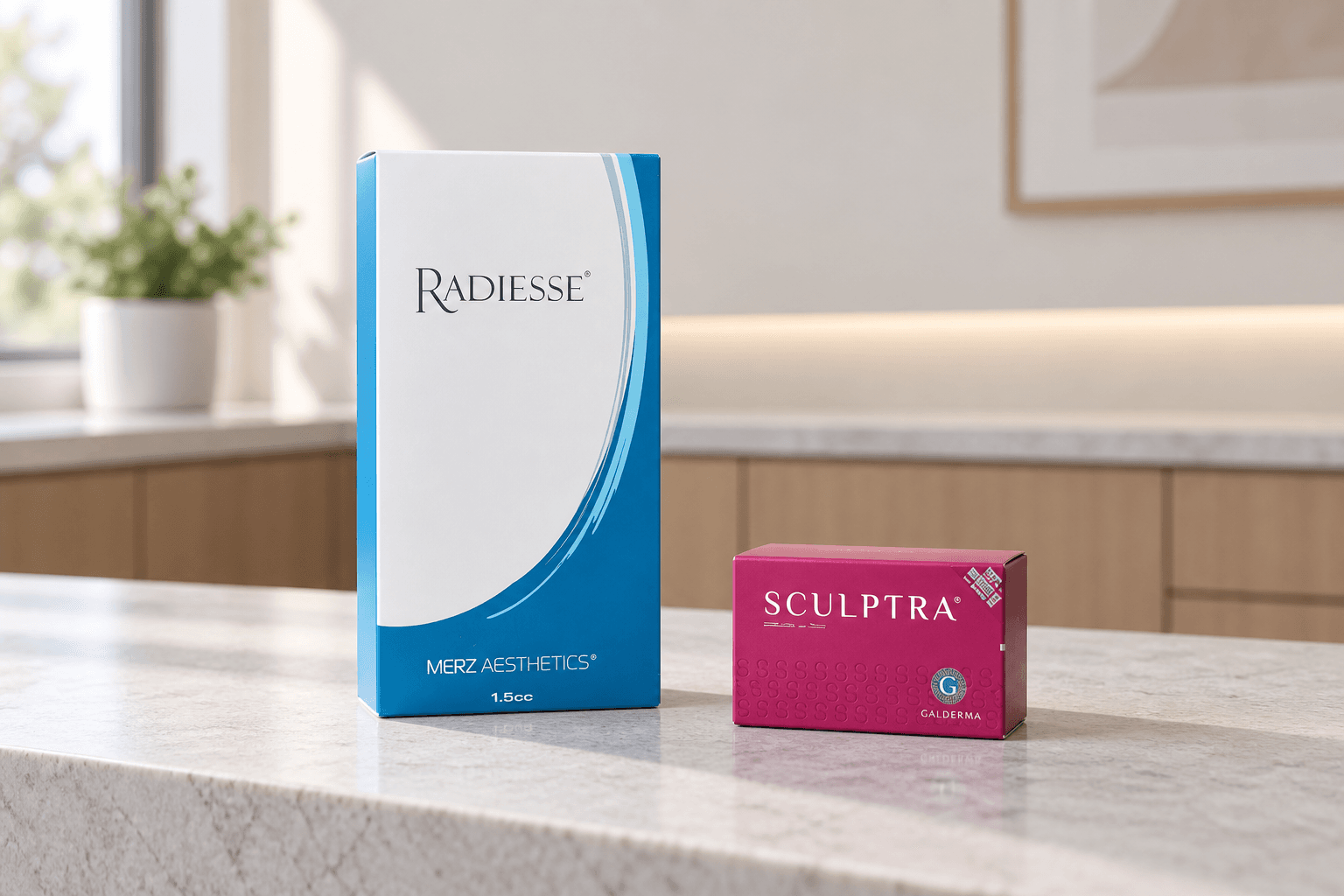
In brief
- Radiesse and Sculptra are not interchangeable brands of the same material. Radiesse contains calcium hydroxylapatite particles in a gel; Sculptra contains poly-L-lactic acid particles and is reconstituted before use.
- Neither product is universally better. The exact version, goal, anatomy, tissue, treatment area, plane, technique, medical history, and applicable local label all matter.
- Day-zero appearance can be misleading. Reconstitution fluid, implanted material, and injection-related swelling do not represent the same thing, and both products can change over the following weeks.
- Neither has a specific on-demand reversal agent equivalent to hyaluronidase for certain hyaluronic-acid fillers.
- U.S. labels describe product- and indication-specific uses. They do not establish Mexican authorization or an individual recommendation.
Short answer: this is a clinical trade-off, not a winner
Radiesse is a cohesive injectable implant containing synthetic calcium hydroxylapatite —CaHA— particles in a water-based gel. Sculptra is an injectable implant containing poly-L-lactic acid —PLLA— particles and is reconstituted into a suspension before use.
Those differences affect early appearance, preparation, treatment planning, and the evidence that should be reviewed. They do not make one product best for every face or goal. The useful question is not “Which brand wins?” but “Which exact product, if either, fits the objective, anatomy, history, and local label being considered?” For the broader category boundary, start with what collagen biostimulators are.
Why the immediate appearance can mislead
An injection can cause swelling, redness, and bruising regardless of product. Radiesse also places a cohesive CaHA-in-gel implant in the tissue, so implanted material may contribute to visible correction or support. That early appearance still does not prove the later outcome; the Radiesse label describes continued improvement over the following weeks.
Sculptra’s U.S. labeling makes a particularly useful distinction. The sterile water used for reconstitution and injection-related swelling can create temporary fullness at the end of a session. That fullness may recede within hours to days, allowing the original contour concern to reappear before gradual change develops over the following weeks.
A day-zero photograph therefore cannot establish which product produced the better later result. It can reflect different proportions of material, fluid, and swelling.
Radiesse vs. Sculptra at a glance
| Dimension | Radiesse | Sculptra |
|---|---|---|
| Material and presentation | Synthetic CaHA particles suspended in a cohesive gel containing water, glycerin, and carboxymethylcellulose. | PLLA particles with carboxymethylcellulose and mannitol; reconstituted into a suspension before use. |
| Early appearance | Implanted material can contribute to visible correction or support, alongside procedure-related swelling. Early appearance is not the final response. | Reconstitution water and swelling can produce temporary fullness that recedes before gradual change develops. |
| Change over time | The treatment effect can continue to evolve over several weeks. Version, dilution when applicable, anatomy, plane, and technique matter. | The label describes gradual correction over several weeks and cautions against overcorrection at the initial session. |
| Planning dependencies | Exact base or lidocaine-containing version, dilution where applicable, distribution, anatomy, injection plane, and technique. | Reconstitution, optional lidocaine, distribution, anatomy, injection plane, and technique. |
| Areas and label boundaries | U.S. labels separate uses such as certain facial folds, the backs of the hands, diluted base product for décolleté wrinkles, and Radiesse (+) for jawline contour. They are not one class-wide indication. | The U.S. label includes certain facial folds and wrinkles, cheek lines, and HIV-associated lipoatrophy. These U.S. uses cannot be carried over automatically to Mexico. |
| Reversal or removal | No specific on-demand reversal comparable with hyaluronidase for HA filler. Management is problem-specific and may be difficult. | Also has no specific hyaluronidase-equivalent reversal. Delayed nodules or other complications require individualized management. |
| Comparative evidence | Product-specific evidence can characterize Radiesse, but direct comparison does not establish a universal winner. | The same limit applies: separate Sculptra trials do not create a valid head-to-head ranking. |
Material support and gradual response are not opposites
Radiesse’s cohesive implant can be used within a clinician’s plan for correction or tissue support. The material is not simply an abstract “collagen stimulator”: its gel carrier, CaHA particles, exact version, preparation, placement, and amount all affect how it behaves. A diluted use is not equivalent to an undiluted use, and Radiesse base should not be conflated with Radiesse (+), which contains lidocaine and has its own labeling.
Sculptra is supplied as a powder and reconstituted. Its later effect is described as gradual, but that does not mean nothing is visible on day zero; fluid and swelling can create temporary fullness. Nor does it mean every response follows a fixed schedule.
The safest comparison is therefore two-dimensional: what is present or visible early, and what response is expected to evolve later. “Immediate versus gradual” is too simple for either product.
Product version, preparation, and technique change the comparison
A brand name does not describe the full procedure. Radiesse base, Radiesse (+), and a specific dilution choice cannot be discussed as though they share every indication and planning assumption. The presence of lidocaine also changes which allergy history is relevant.
Sculptra’s reconstitution volume, any added lidocaine, the distribution plan, and the selected tissue plane are also clinically important. These details explain why two reports using the word “Sculptra” may not describe equivalent treatment. They are not instructions for self-selection or an injection tutorial.
Training and anatomy matter for both. Product placement near vessels, in thin tissue, around prior implants, or in previously treated areas changes the question. A comparison page can identify those dependencies but cannot safely choose a product for an individual reader.
Areas and selection questions a chart cannot answer
U.S. labels provide concrete examples of studied uses, but they are specific to the product version and indication. The base Radiesse labeling covers certain facial wrinkles and folds and HIV-associated facial lipoatrophy, with separate U.S. labeling for hand augmentation and diluted décolleté use. Radiesse (+) has a U.S. jawline-contour indication. Sculptra’s U.S. label covers certain facial wrinkles and folds, cheek lines, and HIV-associated lipoatrophy.
That list is not a menu or a Mexican authorization statement. A clinician still has to consider the goal, tissue thickness, anatomy, prior procedures, current inflammation, healing history, medications, and realistic alternatives. Age, sex, skin tone, or a single facial area does not create a reliable product winner.
Useful selection questions include whether the goal is a specific fold, contour, support, or broader tissue-quality concern; whether the proposed use is on the applicable local label; and how early changes will be separated from the later response.
Safety differences and reasons to postpone
Both reviewed labels advise deferring treatment where active inflammation or infection is present. Both include component hypersensitivity and severe-allergy considerations, and both describe common injection events such as swelling, tenderness, redness, pain, and bruising.
Their contraindications are not identical. The reviewed U.S. Radiesse base IFU expressly lists bleeding disorders. The Sculptra labeling expressly lists a history of or susceptibility to keloid formation or hypertrophic scarring. Lidocaine allergy is relevant only when lidocaine is included or added; it should not be assigned to every version automatically.
Pregnancy, breastfeeding, age limits, prior filler use, and long-term safety statements are scoped differently across product versions and indications. They should be quoted from the exact applicable document rather than converted into class-wide rules.
Delayed papules, nodules, granulomatous reactions, infection, inflammation, discoloration, and scarring can occur. Rare accidental injection into a blood vessel can cause tissue necrosis, visual loss or blindness, and stroke. Unusual pain, pale or blue-gray skin, a vision change, or neurologic symptoms during or shortly after an injection require immediate medical attention.
Reversal and removal are not the same as HA filler
Neither CaHA nor PLLA has a specific on-demand reversal agent equivalent to hyaluronidase for certain hyaluronic-acid fillers. That does not mean every complication is untreatable or that the two materials are managed identically.
The U.S. FDA explains that reducing or removing filler material can require injections, procedures, or surgery, and that removal may be difficult or impossible for some materials. Management depends on the exact problem. A nodule, infection, overcorrection, inflammatory reaction, and vascular emergency require different assessment.
Proposed approaches reported in the literature should not be marketed as reliable “dissolvers.” In particular, sodium thiosulfate should not be presented as an established, FDA-approved reversal agent for CaHA filler.
What direct evidence can — and cannot — tell us
Instructions for use and FDA review documents are strong sources for formulation, studied indications, contraindications, and observed adverse events. They do not answer which product is best across patients.
The available direct publications are not strong outcome comparisons. Some are small, short, off-face, or focused on laboratory surrogates rather than meaningful facial outcomes. Those designs can generate hypotheses, but they cannot establish a universal patient-level winner and are not used here as the basis for a recommendation.
Reviews that place CaHA and PLLA studies side by side also combine different populations, areas, preparations, follow-up periods, and outcome measures. A result from one product’s trial cannot be compared numerically with another product’s separate trial as if participants had been randomized head to head.
The defensible conclusion is limited but useful: the products differ, the decision is clinically dependent, and current direct evidence does not support a universal ranking.
Questions to ask before choosing
- What exact product and version are being considered?
- What specific change is the plan intended to address?
- Is the proposed area and use included in the current local labeling?
- How much of the early appearance may reflect material, fluid, or swelling?
- What later change is expected, and when will it be assessed?
- Which medical history, prior procedures, or medicines change the plan?
- What alternatives have a different risk, timing, or reversibility profile?
- How would an early reaction, delayed nodule, infection, or vascular event be managed?
For a non-individualized overview of the clinic’s treatment category, see collagen biostimulator treatments in Mexico City.
Sources
- Merz Aesthetics. Radiesse Injectable Implant: Instructions for Use, IN00244-00/April 2026.
- Merz Aesthetics. Radiesse (+) Lidocaine: Instructions for Use, April 2023.
- U.S. Food and Drug Administration. Radiesse Injectable Implant, PMA P050052/S162. U.S. decision date: March 31, 2026.
- Galderma Laboratories. Sculptra: U.S. Instructions for Use, revised June 2023.
- U.S. Food and Drug Administration. Sculptra, PMA P030050/S039: Summary of Safety and Effectiveness Data.
- U.S. Food and Drug Administration. Dermal Fillers (Soft Tissue Fillers).
- U.S. Food and Drug Administration. Executive Summary: General Issues Panel Meeting on Dermal Fillers. August 13, 2025.
- Ferreira ACM, et al. Efficacy, durability, and safety of PLLA- and CaHA-based collagen biostimulators in the face: a systematic review. Use for context and limitations, not a superiority claim.
Reviewed by our medical team
Dra. Jessica Tapia
Medical Director
Clinical content on this blog is reviewed by the Juvenalia Brío medical team for scientific accuracy and consistency with the care we provide.