In brief
- The epidermis is the outer barrier and contains cells that make keratin and pigment.
- The dermis provides support and elasticity and contains collagen, elastin, blood vessels, nerves, follicles, and glands.
- The hypodermis or subcutaneous tissue contains fat and connective tissue that cushion, insulate, and connect skin to deeper structures.
- Skin changes with age, but there is no universal age at which everyone begins losing exactly 1% of collagen per year.
- Sun exposure is one of the most important modifiable causes of skin aging. Sun protection and avoiding tanning matter more than promises of “total regeneration.”
- A peel, laser, filler, or microneedling device does not always act in a single layer. Depth depends on the product, device, settings, anatomy, and indication.
- Aesthetic procedures have risks and should be selected by diagnosis, evidence, and product or device authorization—not by a commercial “skin layer” chart.
Skin structure: layers, functions, and aging
Skin is the body’s largest organ. It forms a barrier against the environment, helps regulate temperature, participates in immune defense, and lets us sense touch, pressure, pain, and temperature.
For practical purposes, patient resources describe the epidermis, dermis, and hypodermis. Some anatomy texts reserve the word “skin” for the epidermis and dermis and describe the hypodermis as underlying subcutaneous tissue. Both explanations are common; what matters is not turning this diagram into a rigid treatment map.
The layers of skin
| Structure | What it contains | Main functions |
|---|---|---|
| Epidermis | Keratinocytes, melanocytes, and immune and sensory cells | Barrier, surface renewal, pigmentation, and defense |
| Dermis | Collagen, elastin, blood vessels, nerves, follicles, and glands | Strength, flexibility, sensation, nourishment, and temperature regulation |
| Hypodermis or subcutaneous tissue | Fat, connective tissue, larger vessels, and nerves | Cushioning, insulation, energy storage, and connection to deeper structures |
The thickness of each part varies greatly by body area, age, and person. A measurement from an eyelid, palm, or abdomen does not describe all skin.
Full description of the diagram
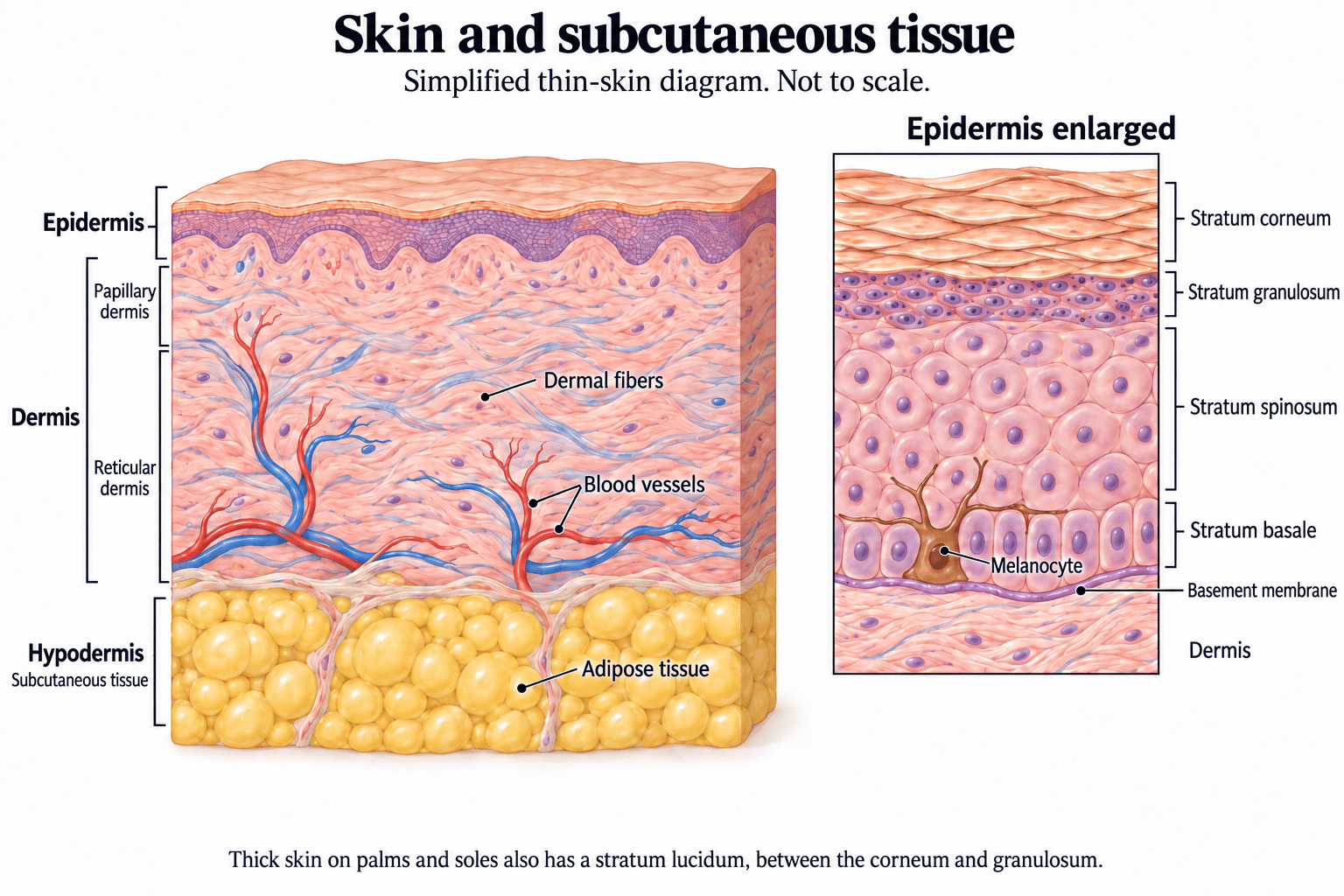
The diagram shows a simplified cross-section of thin skin and the subcutaneous tissue beneath it. The main view runs from the surface at the top to deeper tissue below. The inset shows the full epidermis and its junction with the dermis. Neither panel represents measured thickness at a particular facial site.
The epidermis is the outermost layer. Below it, the dermis has a superficial papillary region and a deeper reticular region. Connective-tissue fibers and blood vessels are shown in the dermis; the vessels do not enter the epidermis. Beneath the dermis, the hypodermis, or subcutaneous tissue, contains the illustrated groups of fat cells. The epidermis and dermis constitute the skin proper.
The inset depicts the typical four-stratum organization of thin-skin epidermis. From the surface downward:
- Stratum corneum: flattened surface cells without nuclei.
- Stratum granulosum: flattened cells containing visible granules.
- Stratum spinosum: several rows of polygonal cells.
- Stratum basale: a single cell row above the basement membrane. The illustrated melanocyte has its cell body in this basal row, with branches extending between neighboring cells.
The basement membrane marks the epidermal–dermal boundary; it is not an additional epidermal stratum. Dermis is shown beneath it. Thick skin on the palms and soles includes an additional stratum lucidum between the corneum and granulosum. That stratum is not drawn in this thin-skin inset.
Original illustration created with AI. Anatomical references: OpenStax, Anatomy and Physiology 2e, Section 5.1, Duke, Integumentary System Histology, and the University of Leeds' Skin Layers and Cell Types in the Epidermis.
Epidermis: the outer barrier
The epidermis is the layer we see and touch. It has no blood vessels and receives nutrients from the dermis. Its cells create a barrier that limits water loss and helps keep microorganisms, irritants, and other external agents out.
Main cells
- Keratinocytes: form most of the epidermis and produce proteins and lipids that are essential to the barrier.
- Melanocytes: make melanin, the pigment that contributes to skin color and helps protect cells from ultraviolet radiation. Melanin does not eliminate the risk of sun damage or skin cancer.
- Langerhans cells: participate in immune surveillance.
- Merkel cells: contribute to fine-touch sensation.
Epidermal strata
From deep to superficial, the basal, spinous, granular, and cornified layers are described. The clear layer, or stratum lucidum, is found in thick skin on palms and soles, so it is not accurate to say every body surface has five strata.
Cells form in deeper layers and move toward the surface. Patient sources often summarize this turnover as about a month, but timing varies by body area, age, health, and measurement method. The rule “28 days when young and 40–60 days when older” should not be used to prescribe exfoliation or procedures.
Dermis: support, circulation, and sensation
The dermis lies under the epidermis and is commonly divided into a superficial papillary region and a deeper reticular region. It contains:
- collagen, which provides strength;
- elastin, which helps skin regain its shape;
- extracellular matrix, including naturally occurring hyaluronic acid and other molecules;
- blood vessels that nourish tissue and help regulate temperature;
- nerve endings and sensory receptors;
- hair follicles and oil and sweat glands.
Fibroblasts make and maintain components of the matrix, but they are not an “anti-aging switch.” A product or procedure’s effect on these cells does not by itself prove visible benefit, duration, or clinical safety.
Exact slogans such as “collagen is 75–80% of dry dermal weight,” “hyaluronic acid holds 1,000 times its weight,” or “elastin stops being produced after puberty” are also unnecessary for an aesthetic decision. They are often transferred from laboratory context into marketing without the needed qualifications.
Hypodermis: fat and connective tissue
The hypodermis, also called subcutaneous tissue, lies beneath the dermis. Its fat and connective-tissue partitions:
- cushion impacts;
- help conserve heat;
- store energy;
- carry larger blood vessels and nerves;
- connect skin to muscle and bone;
- contribute to facial and body contour.
Facial fat is distributed in compartments, but facial aging cannot be explained only as “deep fat deflation” plus “superficial fat descent.” Skin, ligaments, muscles, and bone also change. This complexity is one reason not to choose a filler from a layer diagram alone.
Skin appendages
Skin appendages develop from the epidermis and extend into deeper tissue.
- Hair follicles: produce hair and are associated with oil glands.
- Sebaceous glands: produce sebum, which helps lubricate skin and hair.
- Eccrine glands: produce sweat and help regulate temperature.
- Apocrine glands: are concentrated in areas such as the armpits and groin; their secretion can produce odor when bacteria break it down.
- Nails: protect fingertips and assist with fine tasks.
A hair-removal laser targets pigment in the follicle, but the correct result is described as hair reduction, not guaranteed “permanent removal.” Botulinum toxin can temporarily reduce nerve signaling to sweat glands for specific indications; it does not “act in the eccrine layer” because no such anatomical layer exists.
How does skin change with age?
Skin aging combines internal changes and external influences. Over time, skin may become thinner, drier, more fragile, and less elastic; it may lose some subcutaneous fat and heal more slowly.
Ultraviolet radiation accelerates changes in texture, pigment, and elasticity and increases skin-cancer risk. Smoking also contributes to wrinkles. Hormones, genetics, disease, medicines, and environmental exposures modify the process.
There is no identical biological boundary for everyone at age 25 and no linear rate that can calculate a person’s “collagen percentage” from age. It is more useful to discuss risks and protective actions:
- seek shade and wear protective clothing;
- apply broad-spectrum, water-resistant SPF 30 or higher sunscreen to exposed skin;
- avoid tanning beds;
- do not smoke;
- use gentle cleansers and moisturizer when skin is dry;
- have any new, changing, bleeding, or nonhealing lesion assessed.
Which skin layer does an aesthetic treatment reach?
The honest answer is usually: it depends. Even two products in the same category can have different indications, concentrations, depths, and risks.
| Category | Relationship to anatomy | Important limit |
|---|---|---|
| Cosmetics and topical retinoids | Meet the surface and epidermis first; some cause broader biological changes | Benefit and risk depend on the ingredient and formulation, not simply saying “it acts in the epidermis” |
| Chemical peels | Can be superficial, medium, or deep according to agent, concentration, time, and technique | A deep peel is a medical intervention; depth and recovery cannot be inferred from the acid name alone |
| Microneedling | Needles cross the surface to a controlled depth | The FDA has authorized only specific devices for specific uses and areas; risks include infection, scarring, and pigment change |
| Lasers and energy devices | Wavelength, energy, and settings determine target and depth | “Laser” is not one treatment, and deeper does not mean better |
| Dermal fillers | Are implanted in soft tissue; the plane depends on product, indication, and anatomy | They can block a blood vessel and cause necrosis, visual impairment, blindness, or stroke |
| Botulinum toxin | Acts at nerve endings to temporarily reduce muscle or gland activity | It does not fill skin or stimulate collagen by belonging to a “layer” |
| Biostimulators and other injectables | Plane and effect depend on the exact product | PDRN, mesotherapy, hyaluronic acid, CaHA, and PLLA should not be grouped under one regeneration promise |
Brand names do not replace labeling. For any injectable or device, ask for the exact name, manufacturer, lot, current Mexican authorization, indication, treatment area, and the operator’s qualifications. U.S. FDA authorization does not establish COFEPRIS authorization in Mexico.
Risks a layer chart does not show
Fillers
Fillers are medical implants, not simply “molecules that replace what was lost.” They can cause swelling, pain, bruising, nodules, infection, and delayed reactions. Their most serious risk is accidental injection into a blood vessel.
Seek immediate medical care if unusual pain, visual change, sudden weakness, or white, gray, or blue skin near the injection appears during or after filler treatment.
Microneedling
Microneedling can cause redness, bleeding, burning, peeling, pigment changes, herpes reactivation, infection, or scarring. The FDA recommends a trained professional and a new cartridge for every person and session. The agency has also not authorized these devices to deliver cosmetics, medicines, vitamins, or PRP into skin.
The repair response varies by person and protocol; see how we explain facial microneedling and its aftercare.
Chemical peels
Recovery and risk depend on depth. A superficial peel may cause redness and scaling; a medium or deep peel can require wound care and prolonged recovery. Pigment changes and scarring are relevant risks, especially when selection or aftercare is inappropriate.
Sources
- Cleveland Clinic. Skin: layers, structure and function. https://my.clevelandclinic.org/health/body/10978-skin
- MedlinePlus. Aging changes in skin. https://medlineplus.gov/ency/article/004014.htm
- MedlinePlus. Skin aging. https://medlineplus.gov/skinaging.html
- National Institute on Aging. Skin care and aging. https://www.nia.nih.gov/health/skin-care/skin-care-and-aging
- American Academy of Dermatology. Wrinkle remedies. https://www.aad.org/public/everyday-care/skin-care-secrets/anti-aging/wrinkle-remedies
- American Academy of Dermatology. Chemical peels: FAQs. https://www.aad.org/public/cosmetic/younger-looking/chemical-peels-faqs
- U.S. Food and Drug Administration. Microneedling devices. https://www.fda.gov/medical-devices/aesthetic-cosmetic-devices/microneedling-devices
- U.S. Food and Drug Administration. Dermal fillers (soft tissue fillers). https://www.fda.gov/medical-devices/aesthetic-cosmetic-devices/dermal-fillers-soft-tissue-fillers
- U.S. Food and Drug Administration. Aesthetic (cosmetic) devices. https://www.fda.gov/medical-devices/products-and-medical-procedures/aesthetic-cosmetic-devices
Reviewed by our medical team
Dra. Jessica Tapia
Medical Director
Clinical content on this blog is reviewed by the Juvenalia Brío medical team for scientific accuracy and consistency with the care we provide.