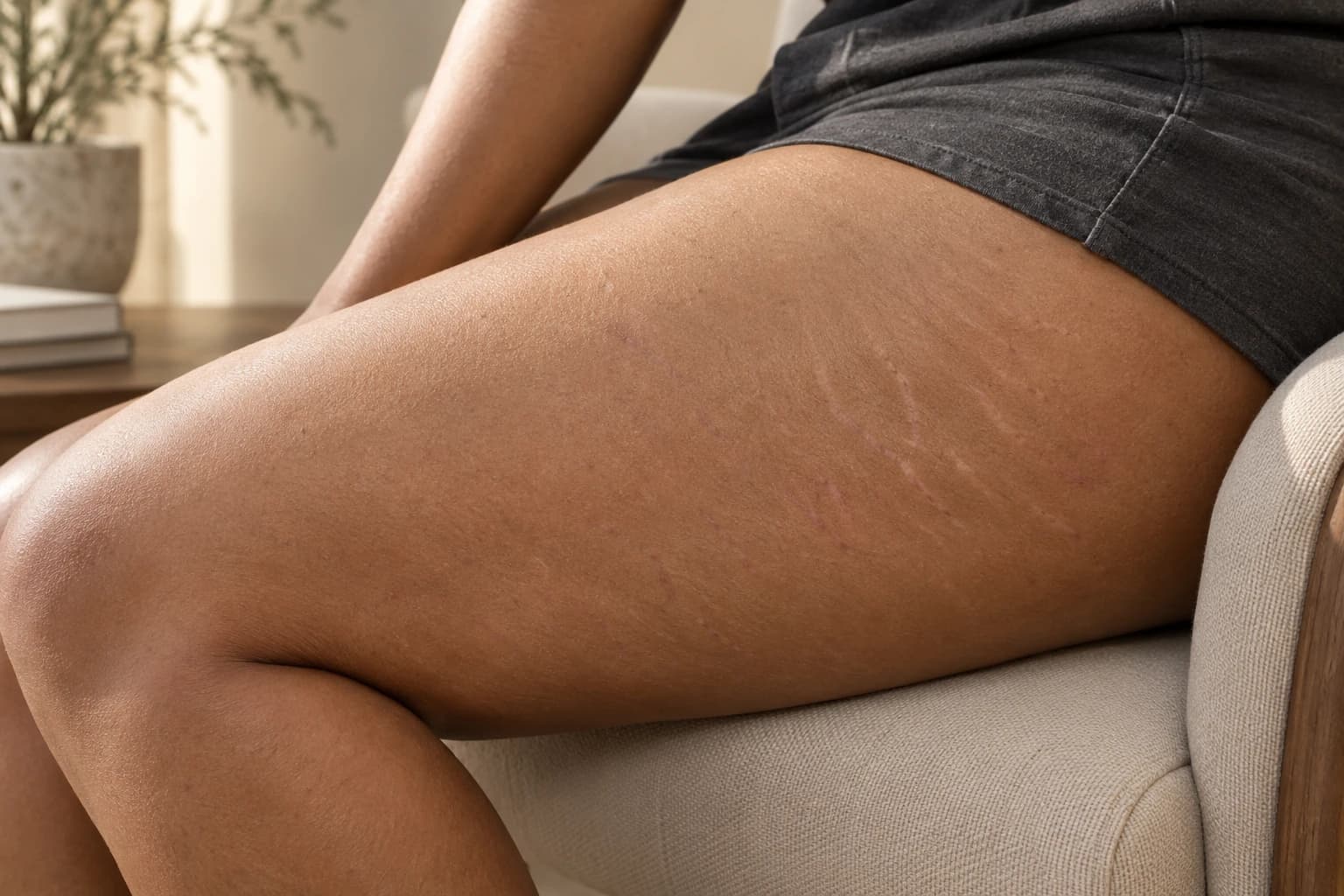
Stretch Marks: What They Are, Why They Appear, and How to Treat Them
Stretch marks are scars that form in the dermis—the middle layer of skin—when tissue stretches faster than its collagen and elastin fibers can support. They are not a superficial or minor cosmetic problem: they represent a real structural breakdown of connective tissue. They affect between 50% and 90% of pregnant women and are extremely common during puberty, rapid weight changes, and corticosteroid use.
The good news is that evidence-based treatments exist that can significantly improve their appearance, especially when intervention occurs in the early (red) phase. The key is understanding what they are, why they appear, and when to act.
Summary
- Stretch marks are dermal scars caused by collagen and elastin fiber rupture in the reticular dermis, not a surface skin problem.
- Red stretch marks (striae rubrae) retain blood supply and active inflammation, making them much more responsive to treatment than white ones (striae albae).
- Microneedling is one of the most scientifically supported treatments: it is safe for all skin phototypes and stimulates natural collagen production.
- Cocoa butter and olive oil lack solid scientific evidence for preventing stretch marks, despite their popularity.
- No treatment eliminates stretch marks 100%, but combined protocols (microneedling + PRP or PDRN) achieve clinically significant improvements.
What are stretch marks?
Stretch marks—known in medicine as striae distensae—are linear scars that form when the reticular dermis loses its structural integrity. Unlike an external wound, the damage occurs from within: the collagen and elastin fibers that provide firmness and elasticity to skin rupture under excessive mechanical tension.
When this happens, an inflammatory response similar to any wound is triggered. Cells called mast cells release enzymes like elastase, which further degrade elastic fibers. Initially a reddish or purplish mark appears (red stretch mark or striae rubrae) with dilated blood vessels and active inflammation. Over time, inflammation resolves, vessels contract, and the stretch mark matures into a whitish, flat, atrophic scar (striae albae).
This process explains something fundamental: stretch marks are not hyperpigmentation or a stain that can be "erased" with a depigmenting cream. They are a three-dimensional alteration of dermal tissue, with changes in collagen, vascularization, and skin texture.
Why do stretch marks appear?
Stretch marks appear when skin stretches faster than its collagen structure can adapt, combined with hormonal factors that weaken elastic fibers. The main causes are:
Pregnancy
It is the most common cause. Gravitational stretch marks (striae gravidarum) affect between 50% and 90% of pregnant women and typically appear on the abdomen, breasts, hips, and thighs. The rapid stretching of the abdomen in the third trimester, combined with hormonal changes (increased cortisol, estrogens, and relaxin), weakens collagen fibers and facilitates rupture.
Puberty and rapid growth
Growth spurts during adolescence are the second most common cause. In women, stretch marks typically appear on hips, thighs, and breasts. In men, on shoulders, back, and thighs. Rapid skeletal growth stretches skin before connective tissue can remodel itself.
Rapid weight changes
Both rapid weight gain and loss can cause stretch marks. The most affected areas include the abdomen, flanks, and inner thighs. The speed of change matters more than total weight.
Strength training and muscle building
Rapid increase in muscle mass stretches skin over growing muscles. Typical areas are shoulders, biceps, and pectorals. It is especially common when muscle gain is accelerated.
Corticosteroids
Glucocorticoids—both systemic (prednisone, dexamethasone) and topical applied long-term—weaken collagen and elastin fibers. Cortisol inhibits the activity of fibroblasts, the cells responsible for producing and repairing collagen. Corticosteroid-induced stretch marks can appear in any area where the product is applied, and in Cushing's syndrome (endogenous excess of cortisol) they are a characteristic finding.
Genetics and connective tissue disorders
Genetic predisposition plays an important role. If your mother or sisters have stretch marks, your risk is higher. In extreme cases, hereditary connective tissue diseases like Marfan syndrome (fibrillin mutation, essential for elastic fibers) or Ehlers-Danlos syndrome are associated with extensive and early stretch marks.
Red vs. white stretch marks: two phases, two prognoses
Red (striae rubrae) and white (striae albae) stretch marks are not different types of stretch marks: they are two evolutionary phases of the same lesion. The difference between them determines the prognosis and treatment response.
| Characteristic | Red stretch marks (striae rubrae) | White stretch marks (striae albae) |
|---|---|---|
| Color | Reddish, pink, or purplish | White, pearlescent, or hypopigmented |
| Phase | Early / active (months to ~1-2 years) | Mature / chronic (more than 1-2 years) |
| Blood supply | Increased (dilated vessels) | Decreased (contracted vessels) |
| Inflammation | Present and active | Absent or minimal |
| Texture | Slightly elevated, can be sensitive | Flat, atrophic, depressed |
| Prognosis | Favorable — responds well to treatment | More difficult — partial improvement, no disappearance |
| Treatment response | High (up to 49% improvement with microneedling) | Moderate (up to 42% improvement with microneedling) |
Why does this distinction matter?
Red stretch marks retain inflammatory and vascular activity. This means that treatments that stimulate collagen remodeling—such as microneedling—have more "biological material" to work with: there is blood flow that carries growth factors, active fibroblasts, and an extracellular matrix that is still being reorganized.
White stretch marks, on the other hand, represent already mature scar tissue. Collagen fibers are reorganized in parallel patterns (like a scar), vascularization is minimal, and there is no active inflammation. Treating them is possible—a study published in Aesthetic Surgery Journal demonstrated 42% improvement in striae albae with microneedling—but it requires more sessions and results are more gradual.
The clinical conclusion is clear: if you notice new red or purple stretch marks, it is the optimal time to consult a professional treatment.
Professional evidence-based treatments
No treatment completely eliminates stretch marks, but several have demonstrated clinically significant improvements in texture, color, width, and length of marks. The key is selecting treatment based on the phase of the stretch mark and skin phototype.
Microneedling: percutaneous collagen induction
Microneedling is one of the most scientifically supported treatments for stretch marks. It works by creating controlled microperforations in the dermis that activate the natural wound healing cascade: controlled inflammation → growth factor production → synthesis of new collagen and elastin (neocollagenesis and neoelastogenesis).
A clinical study published in Aesthetic Surgery Journal in 2025 evaluated microneedling as an independent treatment for red and white stretch marks in 29 patients with phototypes I to VI. Results at 6 months showed 49% improvement in red stretch marks and 42% improvement in white stretch marks according to the Manchester Scar Scale, with significant reductions in length (24% in rubrae vs. 17% in albae). 100% of patients with red stretch marks reported improvement in color, contour, texture, and overall appearance.
An important advantage of microneedling over other treatments like fractional CO₂ laser: the risk of postinflammatory hyperpigmentation is significantly lower, making it the preferred option for darker skin phototypes (IV-VI). Multiple reviews confirm its safety profile for darker skin.
The standard protocol includes 3 to 6 sessions spaced 4 weeks apart, with progressive improvement continuing up to 6 months after the last session thanks to the dermal remodeling process.
At Juvenalia Brío we use the Nanopore system for microneedling, a precision micro-perforation device that allows adjusting needle depth based on body area and type of stretch mark.
Microneedling combined with PRP
The combination of microneedling with platelet-rich plasma (PRP) has shown results superior to microneedling alone. A study published in Journal of Cutaneous and Aesthetic Surgery compared both protocols in patients with stretch marks: the group receiving microneedling + PRP achieved significantly higher satisfaction scores and better results on the global improvement scale (p < 0.05). 87% of patients in the combined group reported being very satisfied with the result.
PRP provides a high concentration of growth factors (PDGF, TGF-β, VEGF) directly into the microperforations created by microneedling, potentiating the tissue repair signal.
PDRN (polynucleotides): cellular regeneration
Polynucleotides derived from salmon DNA (PDRN) represent an emerging regenerative therapy with promising results in stretch marks. They work by activating the A2A adenosine receptor in fibroblasts, stimulating the production of collagen, elastin, and endogenous hyaluronic acid, while also exerting an anti-inflammatory effect.
A study on PDRN for stretch marks demonstrated that 85% of patients showed notable reduction in mark severity, with improvements in volume, width, and skin smoothness. The treatment was well tolerated with minimal side effects.
The combination of PDRN with microneedling is a synergistic protocol: microneedling creates the access channels and repair signal, while PDRN amplifies the regenerative response at the cellular level. At Juvenalia Brío we offer PDRN with Rejuran and Remedium lines.
Chemical peels
Peels with trichloroacetic acid (TCA) and glycolic acid can improve superficial stretch marks by stimulating epidermal renewal and collagen production in the superficial dermis. A study with 70% glycolic acid demonstrated epidermal thickening and increased collagen and elastic fibers in post-treatment biopsies.
Peels are most effective on red stretch marks (striae rubrae) and as part of a combined protocol. As an isolated treatment, their results are more modest than microneedling or fractional laser.
Fractional laser
Fractional laser—both ablative (CO₂) and non-ablative (erbium:YAG)—stimulates fibroblast activity and collagen and elastin production. Pulsed dye lasers (PDL) are particularly effective for reducing redness in red stretch marks (striae rubrae), as they act on vascular chromophores.
It is a treatment with solid evidence, but with an important consideration: the risk of postinflammatory hyperpigmentation is higher than with microneedling, especially in darker skin phototypes. A comparative study reported hyperpigmentation in 33% of patients treated with fractional CO₂ laser.
Radiofrequency
Radiofrequency uses high-frequency alternating current to generate controlled heat in the dermis, inducing contraction of existing collagen and stimulating neocollagenesis. Fractional microneedle radiofrequency (MnRF) has shown results comparable to or better than fractional CO₂ laser with lower risk of hyperpigmentation.
Topical treatments: what works and what doesn't
Topical treatments have a limited but real role in stretch mark management, especially in the early phase and in prevention. The distinction between evidence and marketing is crucial.
With favorable evidence
Tretinoin (retinoic acid) 0.05-0.1%: It is the topical with the most evidence for early stretch marks (red). Studies demonstrate improvements of up to 47% in the appearance of red stretch marks (striae rubrae). It works by stimulating cell renewal and collagen synthesis. It requires a medical prescription. Absolute contraindication: should not be used during pregnancy or breastfeeding due to its teratogenic potential.
Centella asiatica (extract): It is the topical ingredient with the best evidence for prevention of stretch marks during pregnancy. A double-blind clinical trial with Trofolastin (a cream combining Centella asiatica extract, vitamin E, and hydrolyzed collagen-elastin) showed that only 34% of treated women developed stretch marks, compared to 56% of the placebo group. In women with a history of stretch marks during puberty, prevention reached 89%. Centella asiatica stimulates fibroblast proliferation and type I collagen synthesis.
Topical hyaluronic acid: Some formulations combining hyaluronic acid with other actives (allantoin, dexpanthenol, vitamin A) have shown reduced incidence of stretch marks in controlled trials. Its probable mechanism is improved dermal hydration, which facilitates tissue flexibility.
Without evidence or with insufficient evidence
Cocoa butter: Despite being one of the most popular remedies, two randomized, double-blind, placebo-controlled clinical trials found no significant difference between cocoa butter and placebo for preventing pregnancy-related stretch marks. A study published in BJOG with 175 women reported stretch marks in 45% of the cocoa butter group vs. 49% of the placebo group (p = 0.73, not significant). Another study with 300 women confirmed the same results.
Olive oil: Results are contradictory. A controlled study concluded that olive oil "cannot be recommended for stretch mark prevention" as it showed no significant difference with the control group. Another more recent study suggests some reduction in severity, but not in incidence. Overall evidence does not support its use as a reliable preventive method.
Vitamin E (isolated topical application): There is no quality evidence supporting the application of pure vitamin E to prevent or treat stretch marks. When it appears in effective formulations (like Trofolastin), it is accompanied by Centella asiatica extract and other actives, so the effect cannot be attributed to vitamin E alone.
Prevention: what really works
Prevention of stretch marks depends more on controllable factors like the rate of weight change than on any cream or oil. Evidence-based strategies include:
Weight gain control: It is the most important preventive factor, especially during pregnancy. Gradual weight gain within recommended ranges reduces mechanical tension on the dermis. This does not mean caloric restriction—it means avoiding rapid weight increases.
Active skin hydration: Keeping skin well hydrated improves its flexibility and capacity to adapt to stretching. Although hydration alone does not prevent stretch marks, dehydrated skin is more vulnerable to collagen rupture.
Creams with Centella asiatica: As described in the previous section, they are the topical option with the best preventive evidence, particularly during pregnancy.
Topical retinoids (outside of pregnancy): In people at high risk for stretch marks (adolescents in growth spurts, people in muscle gain programs), tretinoin prescribed by a doctor can strengthen dermal collagen renewal. Should not be used during pregnancy.
Frequently Asked Questions
What are stretch marks?
Stretch marks are linear scars that form in the reticular dermis when collagen and elastin fibers rupture from excessive skin stretching. Medically they are known as striae distensae. Unlike stains or superficial lesions, stretch marks represent structural damage to the middle layer of skin. They initially appear as reddish or purplish lines (red stretch marks or striae rubrae) due to inflammation and blood vessel dilation. Over time, inflammation resolves and the marks mature into whitish, flat, and atrophic lines (striae albae). They are extremely common: they affect most pregnant women and a large percentage of teenagers during puberty.
Why do stretch marks appear?
Stretch marks appear when skin stretches faster than its support fibers can adapt, especially in the presence of hormonal factors that weaken collagen. The most common causes are pregnancy, growth spurts during puberty, rapid weight changes, accelerated muscle gain, and prolonged corticosteroid use. Glucocorticoids—both those produced by the body (cortisol) and those applied in creams—inhibit the activity of fibroblasts, the cells that produce and repair collagen. Genetics also significantly influence risk: if your mother or sisters have stretch marks, your risk is higher. In rare cases, connective tissue diseases like Marfan syndrome or Ehlers-Danlos syndrome predispose to extensive stretch marks.
What is the difference between red and white stretch marks?
Red stretch marks (striae rubrae) are the early phase and white ones (striae albae) the mature phase of the same lesion. Red ones show active inflammation, dilated blood vessels, and a collagen matrix that is still being reorganized, making them significantly more responsive to treatment. White ones represent already stabilized scar tissue, with minimal vascularization and collagen fibers reorganized in parallel patterns. This distinction is clinically relevant: microneedling studies show up to 49% improvement in red stretch marks versus 42% in white ones. If you notice new reddish or purple stretch marks, it is the ideal time to begin professional treatment.
Can stretch marks be completely eliminated?
No. No current treatment completely eliminates stretch marks. However, professional treatments can achieve clinically significant improvements in color, texture, width, and length of marks. Microneedling has demonstrated reductions of up to 49% in red stretch mark severity scores and up to 24% reduction in length. Combined protocols (microneedling + PRP or PDRN) enhance these results. Red stretch marks respond considerably better than white ones. Realistic expectations are: notable improvement, not complete elimination.
What is the most effective treatment for stretch marks?
Microneedling is the treatment with the best balance between efficacy, safety, and versatility for stretch marks. It has robust clinical evidence, works on both red and white stretch marks, and is safe for all skin phototypes (I to VI), including darker skin where other treatments like fractional laser present greater risk of hyperpigmentation. The combination of microneedling with PRP has demonstrated statistically superior results to microneedling alone in comparative studies. The final choice depends on the phase of the stretch mark, skin phototype, and body area. An aesthetic physician can design a personalized protocol.
Does microneedling work for stretch marks?
Yes. Microneedling is one of the most scientifically supported treatments for stretch marks. A 2025 clinical study published in Aesthetic Surgery Journal demonstrated progressive improvements in red and white stretch marks after four monthly sessions, with results continuing to improve up to 6 months after the final treatment. The mechanism is percutaneous collagen induction: controlled microperforations activate the wound healing cascade, stimulating production of new collagen and elastin in the dermis. 100% of patients with red stretch marks reported improvement in color, contour, and texture. In white stretch marks, 95% reported improvement in most evaluated categories.
Do pregnancy stretch marks disappear?
Pregnancy stretch marks (striae gravidarum) do not disappear spontaneously, but they do evolve. Red stretch marks that appear during pregnancy gradually lose color and become whitish over time, becoming less visible. However, atrophic marks (sunken) and texture changes persist. Professional treatments can be started after breastfeeding is complete—tretinoin and certain procedures are contraindicated during pregnancy and breastfeeding—. Microneedling is particularly suitable for postpartum stretch marks because it has no phototype restrictions and its safety profile is excellent.
Does cocoa butter prevent stretch marks?
No. Two randomized, double-blind, placebo-controlled clinical trials demonstrated that cocoa butter is not more effective than placebo for preventing pregnancy stretch marks. A study published in BJOG with 175 women found stretch marks in 45% of the cocoa butter group versus 49% of the placebo group, a non-significant difference (p = 0.73). Another study with 300 women in Trinidad confirmed the same results. Cocoa butter hydrates the skin, but hydration alone does not prevent collagen and elastin rupture in the dermis.
At what age do stretch marks appear?
Stretch marks can appear at any age, but are most common during puberty (between ages 10 and 16) and pregnancy. During puberty, rapid growth spurts stretch skin before connective tissue can adapt. In adolescent women, the most affected areas are hips, thighs, and breasts; in adolescent men, shoulders, back, and thighs. They are also common in young adults who experience rapid weight changes or accelerated muscle gain. Risk is not limited to a specific age: any situation involving rapid skin stretching can cause them.
Can white stretch marks be treated?
Yes, although they require more sessions and expectations should be different from red stretch marks. White stretch marks (striae albae) represent mature scar tissue with less vascularization, making treatment response slower. However, a study in Aesthetic Surgery Journal demonstrated 42% improvement in white stretch mark severity scores after microneedling, with 95% of patients reporting visible improvement. Reductions in mark length continued between 3 and 6 months post-treatment. Combined protocols—microneedling with PRP or PDRN—can enhance response in mature stretch marks.
How many microneedling sessions are needed for stretch marks?
The standard protocol includes 3 to 6 sessions spaced 4 weeks apart. The exact number depends on the phase of the stretch mark (red ones may require fewer sessions), body area, and individual response. A key point is that results are progressive: collagen remodeling continues for weeks and months after each session. Clinical studies show continued improvement between 3 and 6 months after the final session. For this reason, final result evaluation should not be done immediately after the protocol, but at least 3 months after completing the sessions.
Are stretch marks permanent?
Stretch marks are permanent in the sense that they represent structural damage to the dermis that the body does not spontaneously repair completely. However, "permanent" does not mean "unchangeable." Red stretch marks naturally evolve toward lighter white marks over time. Additionally, professional treatments can significantly improve their appearance: microneedling has demonstrated reductions of up to 49% in severity scores and up to 24% in mark length. Improvement is real and measurable, although complete restoration to the skin's previous state is not an achievable goal with current technology.
