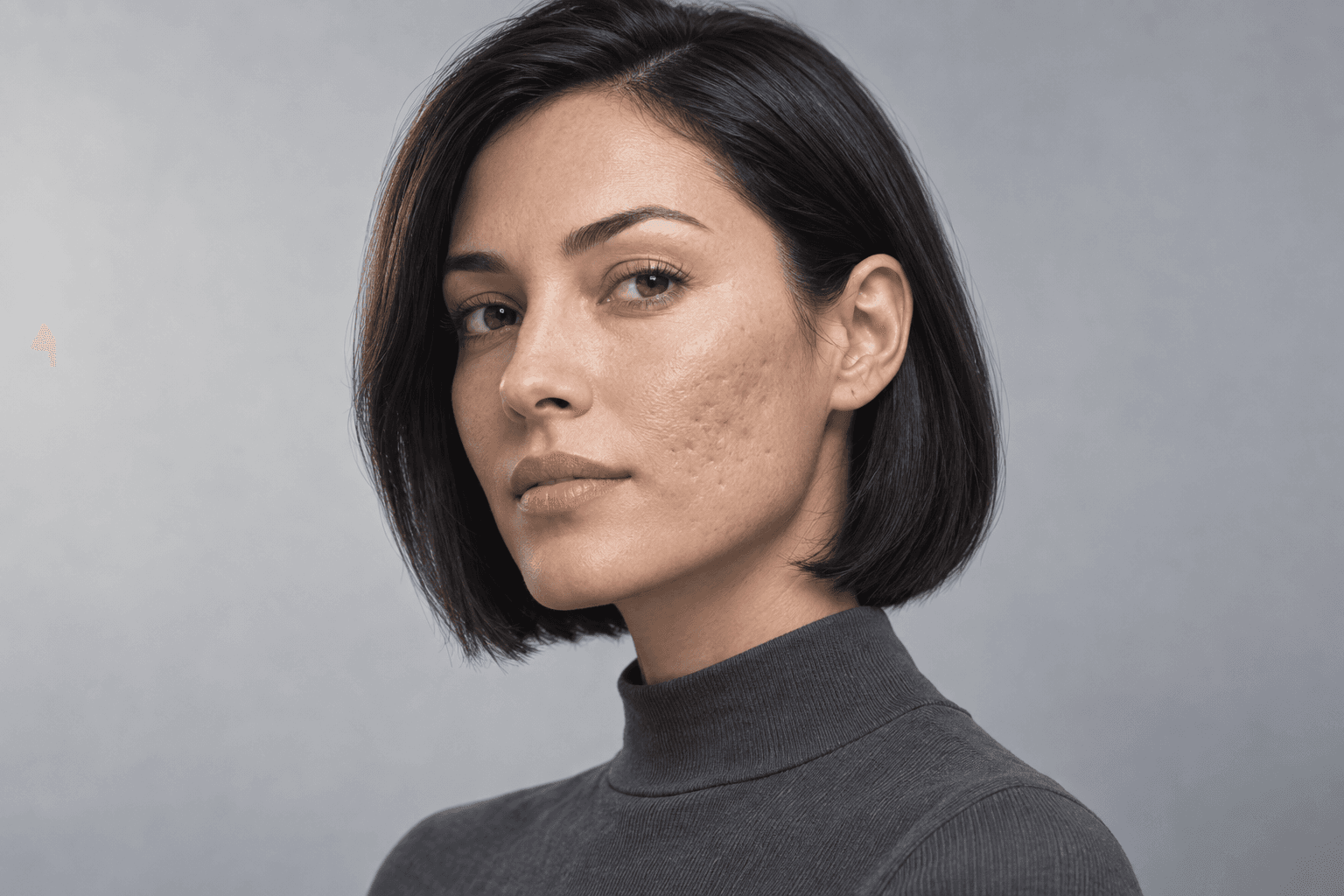
Acne can leave changes in skin color, surface contour, or both. A flat mark is different from a depressed or raised scar. Three common patterns of depressed scars are ice pick, boxcar, and rolling. These names describe their shape; the name alone does not determine which treatment is appropriate. American Academy of Dermatology (AAD)
If you are trying to understand the “pits” or “marks” left after a breakout, start with what concerns you. You do not need to arrive at a consultation with a diagnosis. Nor do you have to change a scar that does not bother you.
Is it a scar, a flat mark, or active acne?
Three different concerns may need attention: acne lesions that are still developing, changes in color after a breakout, and lasting changes in the skin’s contour.
Residual darkening is called post-inflammatory hyperpigmentation; residual redness is called post-inflammatory erythema. Lighter areas, known as hypopigmentation, can also remain. A color change may occur on flat skin or alongside a scar. Not every red mark is hyperpigmentation. DermNet
In practical terms, “I want my skin to look more even” can mean different things. You may be thinking about color, an uneven surface, or new breakouts. Identifying that priority helps avoid using one word for several concerns.
Visible pores and congestion have their own explanation. If these are your main concern, the guide to visible pores and skin texture addresses them without treating every visible opening as a scar.
Depressed scars: ice pick, boxcar, and rolling
Atrophic scars create depressions in the skin. This comparison describes three common shapes. It is not a severity scale or a way to identify your own skin from a photograph. The descriptions follow patient guidance from the NHS and DermNet.
| Pattern | How its contour is described | What appearance alone cannot establish |
|---|---|---|
| Ice pick | A narrow, deep depression with a small opening. | Whether a small-looking opening is superficial or would require only a minor intervention. |
| Boxcar | A round or oval depression with distinct edges. | Its depth in that person or what improvement would be realistic. |
| Rolling | A broad depression with sloping edges and an undulating appearance. | Whether all unevenness in the area belongs to the same pattern. |
Visible shape is only one part of an assessment. You can ask: “Which patterns are present, and what other features matter when deciding the next step?”
Raised scars require a different distinction
Hypertrophic scars rise above the skin but stay within the boundaries of the original lesion. Keloids can extend beyond those boundaries and continue growing. A hypertrophic scar may become less noticeable over time; a keloid does not usually fade on its own. AAD: keloids
Not every bump after acne is a keloid. Other raised forms, including papular scars, also exist. AAD: scar types
“Treating a scar” therefore does not always mean trying to fill a depression. Before considering an option, clarify what tissue is being assessed and which change is being sought. Two findings can both be called scars while presenting different concerns.
More than one pattern can occur in the same area
People often have more than one type of depressed acne scar. AAD Changes in color and contour can also occur together. DermNet
Imagine a consultation in which someone is mainly concerned about a dark mark, but a depression is also visible. It would help to agree which aspect matters most and how a change in color would be distinguished from a change in contour.
What an assessment needs to clarify
An assessment considers scar type, number, and location, along with skin tone, age, treatment history, and expectations. Choosing a category in a table is not enough. AAD: consultation and treatment
You can organize the conversation around four areas:
- What you notice: when it became noticeable, where it is, and which feature concerns you most.
- What has happened before: breakouts, treatments you have used, and how your skin responded.
- What you want to change: a specific priority rather than a general expectation of “perfect skin.”
- What you need to understand: alternatives, possible unwanted effects, recovery, and how progress would be reviewed.
You do not need to decide whether a scar is deep, tethered, or a particular type before your visit. Describe it in your own words and ask for an explanation of the findings. Include any history of raised scars or color changes following previous procedures.
If you are still having breakouts
Active acne is usually addressed before procedures for acne scars, with the aim of reducing inflammation and preventing new scarring. Current and previous medications can also affect planning. AAD
A useful question is: “Which part needs attention now, and which part should be assessed later?” The answer should relate to your circumstances. This guide does not set a fixed waiting period or advise starting or stopping medication.
Why there is no single best option for every scar
The choice depends on the scar, the skin, and the severity of the changes. No single option is best for everyone. Mayo Clinic, in Spanish
Before comparing procedure names, ask for a clear goal. Is the proposal intended to change color, soften an uneven contour, or address raised tissue? Then ask what falls outside that goal. An explanation of what may improve and what may remain visible is more useful than a promise to erase every mark.
The explanation of facial microneedling discusses that option and individual assessment. Being part of some treatment plans does not make a procedure appropriate for every scar. For a broader overview, the facial treatments guide organizes other considerations without replacing a scar assessment.
If you are weighing a home device against an appointment, read our at-home vs professional microneedling guide.
A realistic aim is to improve appearance without guaranteeing complete removal. NHS Before starting, you can also agree what change would feel worthwhile, how it would be documented, and when it would make sense to reconsider the plan.
Microneedling for acne scars: what results have been studied?
Microneedling can improve the appearance of some facial acne scars, but the device and the concern being treated matter. The FDA has authorized specific devices for this purpose; that does not authorize every roller, pen or combination with added products. FDA: microneedling devices.
Two studies help explain what improvement can mean and which questions to ask before starting:
| Evidence | What was observed | Important limitation |
|---|---|---|
| Alam and colleagues’ 2014 trial: 15 people completed three treatments; one side of the face received conventional microneedling and the other served as a control. | Six months after the first treatment, the treated side's scar score had improved compared with its starting score. | This was a small trial and could not establish the result for each scar type separately. Original study. |
| SkinPen Precision evidence reviewed by the FDA: 20 people completed follow-up with the final device after three treatments. | Six months after the last treatment, 11 of 20 showed some improvement on the scar scale; 7 of those 11 improved by a full grade. The other 9 had no change in score. | These are findings for that device and group, without an untreated control group, rather than a prediction for every device or patient. FDA review. |
Improvement in 11 of 20 people does not mean their scars were reduced by 55%. That figure counts people with a change on a rating scale. It does not mean scars were erased. The studies used different assessments and follow-up times, so their results cannot be used to rank the devices from best to worst.
How many sessions, and when should you assess the change?
A study using three treatments does not establish three sessions as the right course for every person. Before committing to a series, ask what change is expected in your scars, when it will be compared with your starting point, and what would prompt a different plan. The FDA notes that several sessions may be needed and the desired result is not guaranteed. FDA patient guidance.
When reviewing photographs, compare the same feature—contour or color—with similar lighting and angles. A picture taken immediately afterward does not answer the same question as an assessment months later. Agree on how progress will be documented before starting.
Confirm the technology being proposed
These examples concern conventional needling. RF microneedling adds energy that heats tissue. In October 2025, the FDA reported serious complications with certain uses of that technology; results and risk profiles should not be transferred from one approach to the other. FDA safety communication.
Conventional microneedling can also cause bleeding, redness, discomfort, infection or pigment changes. Assessment needs to consider your skin and medical history alongside the proposed device. The U.S. documents cited here do not establish which device is available at the clinic or its authorization in Mexico. FDA safety information.
Questions to bring to a consultation
- Is my concern about color, contour, active acne, or a combination?
- Which patterns are present, and which matter most for my priority?
- What would the proposed option change, and what might stay the same?
- How do my medications, previous treatments, and healing history affect the decision?
- Which possible unwanted effects are relevant to me?
- What alternatives are available, including choosing no treatment?
- How would progress be assessed, and what would lead us to change the plan?
These questions do not need to become a shopping list of procedures. They are intended to help you understand a proposal and decide whether it fits what you want.
Further reading
The references linked alongside each explanation include resources from the AAD, NHS, DermNet and Mayo Clinic, alongside the clinical trial and FDA documents cited in the microneedling section.
Reviewed by our medical team
Dra. Jessica Tapia
Medical Director
Clinical content on this blog is reviewed by the Juvenalia Brío medical team for scientific accuracy and consistency with the care we provide.