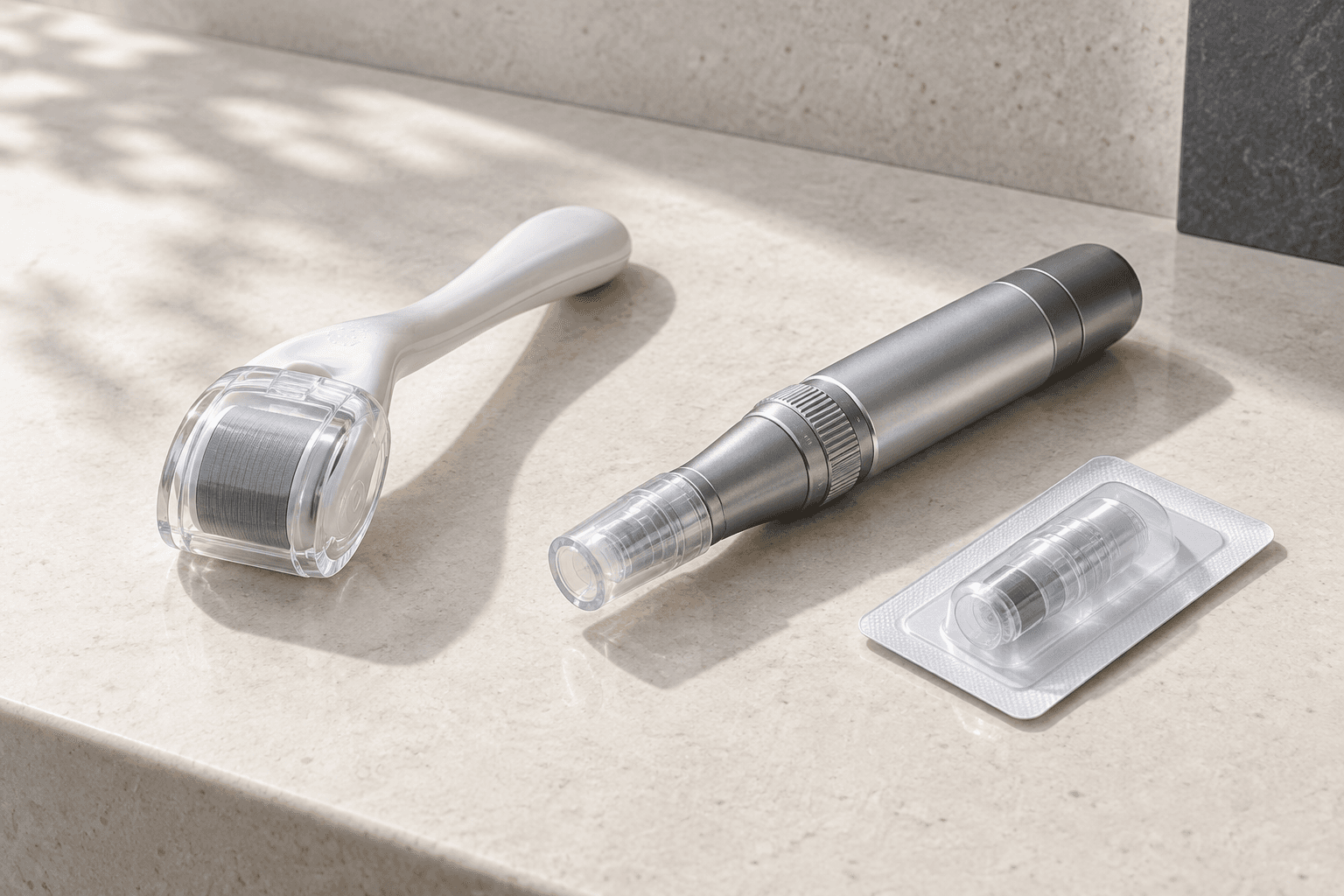
At-home microneedling and professional treatment should not be assumed to produce the same results. The American Academy of Dermatology distinguishes gentler consumer products from medical treatment and warns that home use can still injure skin. Before comparing a roller, pen or appointment, establish what the device actually does and which skin concern you want to address. American Academy of Dermatology.
Start with the device, not the label
“At home” describes where a product is marketed for use; it does not reliably tell you whether it punctures living skin. A roller's shape, a pen's appearance or the word “nano” cannot settle that question.
The FDA's regulatory guidance distinguishes products by their intended use and physical characteristics. A product limited to surface exfoliation is different from a device intended to alter skin structure. Claims about treating scars or stimulating collagen matter when assessing that distinction. FDA regulatory guidance.
| What you are comparing | The distinction to establish | Useful question |
|---|---|---|
| A surface cosmetic product | Its intended action is confined to the outer surface. | What supports the promised cosmetic result? |
| Conventional medical microneedling | Needles puncture the skin; treatment involves clinical assessment. | Is this appropriate for my particular concern? |
| RF microneedling | Needles also deliver radiofrequency energy that heats tissue. | Why is added energy being proposed? |
These categories describe different procedures. The table is not a way to classify an unfamiliar device from its packaging alone. The distinctions follow FDA guidance, Cleveland Clinic's procedure explanation and the FDA's RF guidance.
Can a home roller replace professional treatment?
A gentler product should not be expected to reproduce medical treatment for a scar. Repeated home use can irritate the skin; accidental puncturing can cause infection or scarring, and a device can spread warts or herpes across the skin. Increasing pressure to chase a stronger effect can also cause damage. AAD guidance on home microneedling.
That makes the starting question more specific than “Does microneedling work?” Write down the change you want: a particular indentation, a patch of uneven texture or another concern. Then ask whether the proposed product has evidence for that exact change. A demonstration of immediate glow does not answer every question about longer-term improvement.
What should professional care add?
A consultation should include a skin examination, your health history and a discussion of expectations. It should also leave room to consider a different treatment. Microneedling results develop over time, and a course may involve several appointments; an individual plan matters more than a universal session count. Scarring and infection remain possible even with professional treatment. Cleveland Clinic.
Use the consultation to obtain a concrete explanation: what is being treated, what improvement is realistic and how it will be assessed. If acne scarring is the concern, our guide to types of acne scars explains the distinctions to discuss.
Two details to check: cartridges and added products
Ask whether a fresh needle cartridge will be used for you at every session. The FDA states that cleaning a used cartridge does not make reuse acceptable.
Also ask what, if anything, will be applied with the device. FDA authorization of a microneedling device does not establish approval for delivering a serum, medication or blood product such as PRP into skin. A device claim and a combination-treatment claim need separate scrutiny. These are U.S. regulatory references; they do not establish a device's authorization in Mexico. FDA information for patients.
When to pause before treatment
Active infection, painful or pus-filled acne, and sunburn are reasons to defer microneedling. A history of poor healing, keloids or immune suppression also needs medical assessment. Discuss isotretinoin use with the clinician rather than choosing your own waiting period. AAD suitability guidance.
The FDA also identifies bleeding disorders, blood-thinning medication and pigment changes as relevant considerations. Do not stop prescribed medication on your own. If you already have a complication after treatment, seek medical care promptly. FDA patient guidance.
Does RF microneedling change the decision?
Yes: added heat changes the procedure being considered. On October 15, 2025, the FDA warned of reported serious complications with certain uses of RF microneedling, including burns, scarring, fat loss and nerve damage. Its evaluation remains ongoing. The warning does not provide a complication rate or establish the same risk for conventional needling.
The FDA advises against using RF microneedling devices at home. Discuss the specific device, clinician's training and alternatives before considering treatment. FDA RF safety communication.
What if your goal is surface exfoliation?
Microdermabrasion removes the top layer of skin with a handheld device. It addresses a different level of the skin from medical microneedling. It can also cause irritation and pigment changes, so “surface treatment” does not mean suitable for everyone. AAD microdermabrasion guidance.
Our exfoliation guide explains that separate starting point. Choose the concern first, then assess which approach fits it.
Leave the consultation with a clear plan
Before deciding, make sure you can answer these questions:
- What specific concern are we treating, and what would count as a useful result?
- Which device is proposed, and does it use RF energy?
- What makes me a suitable candidate, and what might change that assessment?
- What recovery should I plan for, and who will assess an unexpected reaction?
- When will we review progress before deciding on further treatment?
For the clinic-specific context, read Juvenalia Brío's microneedling treatment guide in Mexico City.