In brief
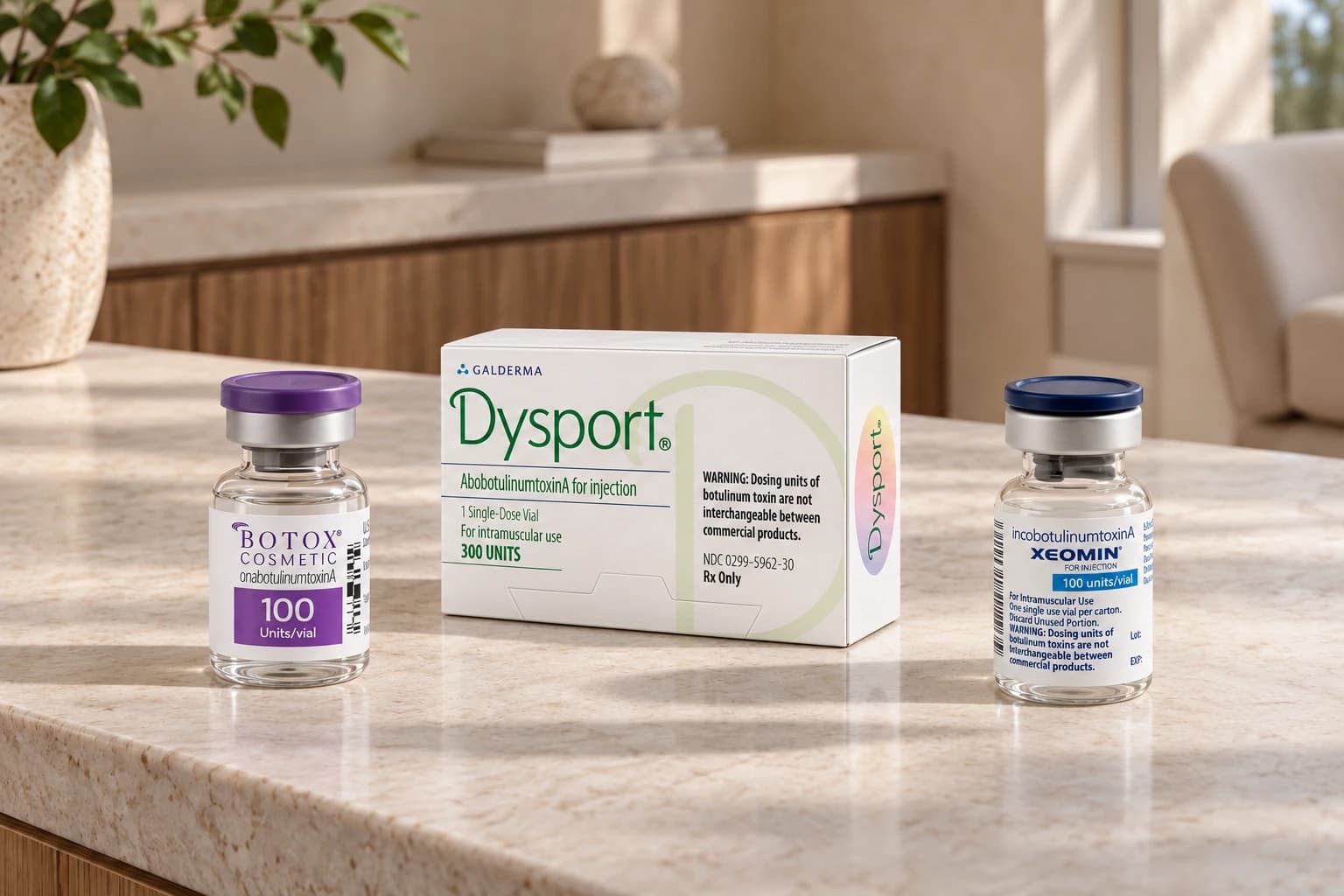
- As of August 2026, the FDA has licensed six injectable botulinum toxin type A products in the United States—Botox, Dysport, Xeomin, Daxxify, Jeuveau, and Letybo—and one type B product, Myobloc.
- That list describes the U.S. market. It does not establish which brands or presentations currently have Mexican registration.
- Units are not interchangeable or convertible between products. There is no universally safe equation such as “1 unit of Botox = X units of Dysport.”
- Indications differ too. Approval for frown lines does not automatically extend to the forehead, crow's feet, neck, bruxism, or sweating.
- These products carry a warning about possible spread of toxin effect. Trouble swallowing, speaking, or breathing requires immediate medical care.
- Choice should be individualized. Tables that universally rank a brand as “faster,” “more precise,” “higher spreading,” or “less immunogenic” oversimplify evidence that is not directly comparable.
Botulinum Toxin Brands: Indications, Differences, and Safety
“Botox” is often used as a generic term, but Botox Cosmetic is a brand of onabotulinumtoxinA. Dysport, Xeomin, Daxxify, Jeuveau, Letybo, and Myobloc are different products with their own active ingredients, units, indications, and labeling.
For a patient, the most important difference is not which brand claims a faster onset or “better spread.” It is whether the exact product is authorized for the proposed use, authentic, stored according to its label, and administered by authorized personnel who understand the anatomy and risks.
Products authorized by the FDA in the United States
This table summarizes aesthetic indications in the current U.S. labels reviewed. It is not a table of Mexican authorizations and does not recommend one product over another.
| Product | Nonproprietary name | Type | U.S. aesthetic indication |
|---|---|---|---|
| Botox Cosmetic | onabotulinumtoxinA | A | Glabellar lines, lateral canthal lines, forehead lines, and platysma bands |
| Dysport | abobotulinumtoxinA | A | Glabellar lines |
| Xeomin | incobotulinumtoxinA | A | Glabellar lines, horizontal forehead lines, and lateral canthal lines |
| Daxxify | daxibotulinumtoxinA-lanm | A | Glabellar lines |
| Jeuveau | prabotulinumtoxinA-xvfs | A | Glabellar lines |
| Letybo | letibotulinumtoxinA-wlbg | A | Glabellar lines |
| Myobloc | rimabotulinumtoxinB | B | No FDA-approved aesthetic indication |
Myobloc is authorized in the United States for adult cervical dystonia and chronic sialorrhea, not cosmetic facial treatment. Daxxify also has a therapeutic indication for cervical dystonia. The table deliberately limits itself to aesthetic indications so that different clinical uses are not mixed together.
“FDA-approved” does not mean “approved in Mexico”
The FDA regulates the United States. In Mexico, the current COFEPRIS registration must be checked for the exact product name, manufacturer, presentation, and concentration.
Before treatment:
- Ask for the full trade name and active ingredient.
- Request the Mexican registration number and compare it with the official records.
- Verify the manufacturer, registration holder, presentation, and concentration.
- Check the lot, expiration date, seal, and vial integrity.
- Confirm that the product came from an authorized distributor.
- Ask for the product and lot to be documented in your medical record.
COFEPRIS has warned about illegally marketed botulinum toxin products, including Linurase. Availability on social media, marketplaces, or in an office does not prove authorization.
Why units cannot be converted
Each manufacturer defines its product's potency through its own biological assay. Official labels warn that units are specific to the preparation and cannot be compared or converted to another botulinum toxin product.
That makes fixed-ratio charts unsafe, including:
- Botox:Dysport;
- Botox:Xeomin;
- Botox:Jeuveau;
- any other cross-brand unit conversion.
A clinician may know each product's authorized regimen and evidence, but should not present a mathematical equivalence as though the units measure the same thing. Dose is selected from the product's local label, indication, and clinical assessment.
This also prevents a common misunderstanding: “more units” of one brand do not necessarily represent a greater biological dose than “fewer units” of another.
Differences that do matter
Authorized indication and treatment area
The proposed area should appear in the product information, or the clinician should clearly explain that the plan is off-label. Consent should distinguish:
- what the regulator authorized;
- what evidence supports the proposed use;
- what additional uncertainty or risk may exist;
- what authorized alternatives are available.
Do not assume every toxin approved for frown lines is also approved for forehead lines, crow's feet, or platysma bands. Current labels show that their scope varies by product.
Formulation and storage
Products can differ in excipients, manufacturing, presentation, preparation, and storage. Those details should come from the vial and current local information, not a generic comparison chart.
For example, the U.S. Xeomin label allows unopened vials to be stored at or below 25°C. That does not make room-temperature storage a clinical advantage or permit anyone to ignore the transport and storage instructions for another presentation. Reconstituted product may have different rules.
Experience with the exact product
Technique, authorized dose, depth, and injection pattern are not interchangeable. A clinician should understand both the anatomy and the specific product being administered.
Authenticity and traceability
An attractive box or visible code is not enough. Identity is checked against the official registration, manufacturer, and authorized distributor, with the lot documented. Do not buy toxin online or bring a self-purchased vial to an appointment.
What a simple comparison cannot establish
“This brand spreads more”
Clinical spread depends on the product, reconstitution, volume, dose, depth, site, and technique. It is not responsible to give every brand a universal “high diffusion” or “high precision” score and use that as an area-selection rule.
“This works faster”
Studies use different designs, doses, scales, and assessment times. Comparing percentages across separate studies does not prove that one brand will act faster for a particular person.
“This lasts longer”
Duration depends on the indication, response definition, authorized dose, and individual. A label or study may report how long an effect persisted for one product and use; that is not a universal promise and cannot be fairly ranked without an appropriate direct comparison.
“This causes less resistance”
All therapeutic proteins have potential immunogenicity. Antibody rates from different labels or studies are not a fair ranking because assays, populations, doses, and exposure differ. If response decreases, anatomy, goal, dose, preparation, interval, technique, and product should be reviewed before attributing it to antibodies.
Jeuveau vs Botox: what direct evidence shows
Jeuveau's active medicine, prabotulinumtoxinA, has been compared directly with Botox Cosmetic's onabotulinumtoxinA. The EVB-003 trial randomized 540 adults with moderate-to-severe frown lines between the eyebrows to a single treatment with either medicine or placebo.
The main measure was none or mild lines at maximum frown on day 30, as rated by the investigator. Among participants included in the per-protocol analysis, 87.2% of the prabotulinumtoxinA group and 82.8% of the onabotulinumtoxinA group met that threshold. PrabotulinumtoxinA met the prespecified noninferiority criterion: the analysis ruled out it performing worse by more than the prespecified margin of 10 percentage points for that outcome.
This supports its effectiveness in the setting studied. It does not establish superiority, identical results, longer duration or equivalent safety. The trial used one treatment, and most participants were women younger than 65. Evolus sponsored the study and participated in its design and funding. EVB-003 full study.
A direct efficacy comparison also does not validate every manufacturing claim. In September 2025, the FDA challenged a Jeuveau newsletter's suggestions that its formulation or manufacturing offered additional benefits, including greater precision or reduced antibody risk, because those advantages had not been demonstrated. FDA's letter.
For a treatment decision, ask whether the evidence addresses your intended area and outcome. The product-specific units and local authorization checks above still apply.
Letybo vs Botox: what the comparison can tell you
Letybo and Botox Cosmetic are different botulinum toxin products. The U.S. Letybo label covers temporary improvement of moderate-to-severe frown lines between the eyebrows in adults. That indication does not establish that it is better than Botox Cosmetic, suitable for every facial area, or authorized in Mexico. The product-specific units and local registration checks above still apply. Current U.S. Letybo label.
There are two different kinds of evidence to separate:
- The U.S. registration trials: BLESS I, II and III compared Letybo with placebo, not Botox Cosmetic. Their results show benefit against that comparator; they do not rank the two brands.
- A direct comparison in China: a randomized trial enrolled 500 adults in China and compared letibotulinum toxin A (identified in the report as BOTULAX) with onabotulinum toxin A (BOTOX). Its main outcome was an evaluator's rating of none or mild glabellar lines at maximum frown after four weeks. The study reported noninferiority for that outcome and followed participants for 16 weeks. Hugel supported the study. Original trial report.
That direct comparison does not establish identical results, superior safety, longer-lasting effects or an interchangeable dose. It also cannot establish the registration or presentation of a product offered in another country. For a useful discussion, ask whether the evidence concerns your intended area and goal—not simply which brand “wins.” This comparison is educational, not a statement that Juvenalia Brío offers Letybo.
Regional names: do not rely on a similar-sounding label
Some products use different trade names across countries; others have similar names without being the same medicine. Identity should be confirmed through the nonproprietary name, manufacturer, and local registration.
One specific error in online comparison tables is claiming that Alluzience is Jeuveau. It is not. Spain's official product information identifies Alluzience as an injectable solution of abobotulinumtoxinA; Jeuveau is prabotulinumtoxinA-xvfs. Aesthetic use does not make them equivalent.
Safety across the category
U.S. labels carry a boxed warning about distant spread of toxin effect from the injection site. Symptoms can appear hours to weeks later and can include generalized weakness, double vision, eyelid drooping, voice changes, trouble articulating words, trouble swallowing, and breathing difficulty.
Seek immediate medical care for trouble breathing, speaking, or swallowing.
Other possible effects depend on the product and area and include pain, swelling, or bruising at the injection site, headache, temporary eyelid or brow droop, asymmetry, weakness of nearby muscles, and hypersensitivity reactions.
Common label contraindications include a known allergy to any botulinum toxin preparation or product component and infection at the proposed injection site. Neuromuscular disorders, pre-existing swallowing or breathing problems, and certain medicines may increase risk and should be discussed before treatment.
Pregnancy and lactation information is limited and differs by label. If you are pregnant, breastfeeding, or planning pregnancy, tell the clinician and review the exact product information together; a universal safety claim is not supported.
Off-label use
“Off-label” means using a product in an area, dose, population, or purpose not included in the relevant authorization. It does not automatically mean the use is wrong, but it does require a clear, specific discussion.
Before accepting an off-label use, ask:
- Which part of the plan is not included in the Mexican label?
- What evidence supports it?
- How do the risks change for this area?
- What authorized alternatives exist?
- What experience does the clinician have with this application?
- How will consent be documented?
Bruxism, masseter treatment, a “lip flip,” the chin, and some neck applications should not be grouped together as “approved” for every brand.
How Juvenalia Brío selects products
At Juvenalia Brío, we use original Botox and Dysport presentations. Selection is not based on a rigid rule such as “one brand for the forehead and another for the eyes.” The exact product, regulatory status, treatment area, anatomy, goal, history, and safety information are reviewed. If you are considering treatment in Mexico City, see our Botox consultation and treatment information.
Before treatment, you may ask to see the vial, lot, expiration date, and traceability documentation. You should also receive the name of the product used for future reference.
Sources
-
COFEPRIS. Drug registration records. https://www.gob.mx/cofepris/documentos/registros-sanitarios-medicamentos
-
COFEPRIS. Alert concerning illegal marketing of Linurase botulinum toxin. https://www.gob.mx/cofepris/articulos/cofepris-alerta-sobre-comercializacion-ilegal-de-toxina-botulinica?idiom=es
-
U.S. Food and Drug Administration. BOTOX Cosmetic (onabotulinumtoxinA): Prescribing Information. 2024. https://www.accessdata.fda.gov/drugsatfda_docs/label/2024/103000s5316s5319s5323s5326s5331lbl.pdf
-
U.S. Food and Drug Administration. DYSPORT (abobotulinumtoxinA): Prescribing Information. 2023. https://www.accessdata.fda.gov/drugsatfda_docs/label/2023/125274Orig1s123correctedlbl.pdf
-
U.S. Food and Drug Administration. XEOMIN (incobotulinumtoxinA): Prescribing Information. 2024. https://www.accessdata.fda.gov/drugsatfda_docs/label/2024/125360s099lbl.pdf
-
U.S. Food and Drug Administration. DAXXIFY (daxibotulinumtoxinA-lanm): Prescribing Information. 2023. https://www.accessdata.fda.gov/drugsatfda_docs/label/2023/761127s002lbl.pdf
-
U.S. Food and Drug Administration. JEUVEAU (prabotulinumtoxinA-xvfs): Prescribing Information. 2019. https://www.accessdata.fda.gov/drugsatfda_docs/label/2019/761085s000lbl.pdf
-
U.S. Food and Drug Administration. LETYBO (letibotulinumtoxinA-wlbg): Prescribing Information. 2024. https://www.accessdata.fda.gov/drugsatfda_docs/label/2024/761225s000lbl.pdf
-
U.S. National Library of Medicine. MYOBLOC (rimabotulinumtoxinB): Prescribing Information. https://dailymed.nlm.nih.gov/dailymed/drugInfo.cfm?setid=675cb354-9d13-482e-8ac2-22f709c58b4f
-
Spanish Agency of Medicines and Medical Devices. Alluzience: Summary of Product Characteristics. https://cima.aemps.es/cima/dochtml/ft/86170/FT_86170.html
-
Hugel / U.S. National Library of Medicine. LETYBO prescribing information, revised November 2024.
-
Xie Y and colleagues. A Phase-III Noninferiority, Randomized Controlled Trial of Letibotulinum Toxin A for Glabellar Wrinkles in China. Plastic and Reconstructive Surgery Global Open. 2024;12:e5525.
Reviewed by our medical team
Dra. Jessica Tapia
Medical Director
Clinical content on this blog is reviewed by the Juvenalia Brío medical team for scientific accuracy and consistency with the care we provide.