In brief
- Hyaluronic acid is a natural polysaccharide present in skin, joints and eyes, capable of retaining up to 1,000 times its weight in water.
- Hyaluronic acid products vary by molecular size and by whether the molecule is cross-linked; cross-linking is a formulation feature, not a molecular-weight category.
- The skin’s hyaluronic-acid content and distribution change with age and sun exposure; there is no single age at which this begins for everyone.
- Topical HA hydrates the outer layers of the skin; injectable HA restores volume, fills wrinkles or improves skin quality from within.
- Some injectable HA products are intended primarily to improve skin smoothness or quality rather than to create facial contour; indications and effects are product-specific.
Hyaluronic acid: what it is, how it works and why it matters for your skin
Hyaluronic acid (HA) is a glycosaminoglycan—a type of polysaccharide—that the human body produces naturally. It is found in the skin, joints, eyes and connective tissue, where it performs functions of hydration, lubrication and structural support. In the skin, approximately 50% of the body's total HA is concentrated in the dermis and epidermis, where it forms a three-dimensional network that maintains moisture and gives volume to the tissue.
What makes this molecule special is its hygroscopic capacity: a single hyaluronic acid molecule can attract and retain up to 1,000 times its weight in water. That property is the basis for both cosmetic serums and injectable dermal fillers. If you are looking for information about specific commercial brands of HA fillers, consult our guide at how to compare hyaluronic acid filler brands safely.
For the options available at the clinic, see information about facial harmonization treatment at Juvenalia Brío.
What is hyaluronic acid at the molecular level
Hyaluronic acid is a linear polymer composed of repetitive units of D-glucuronic acid and N-acetyl-D-glucosamine. Unlike other glycosaminoglycans, it does not bind to a central protein: it is synthesized directly on the cell membrane by enzymes called hyaluronic acid synthases (HAS1, HAS2 and HAS3). Each produces chains of different length and molecular weight.
Its chemical structure gives it a strong negative charge that attracts water molecules, forming a viscous and elastic gel. In the human body of an adult weighing approximately 70 kg, there are approximately 15 g of HA in the form of sodium hyaluronate, and about one-third of that total is degraded and renewed each day.
Where HA is found in the body
Hyaluronic acid is present in virtually all vertebrate tissues, with especially high concentrations in three areas:
- Skin: Contains approximately 50% of total body HA. In the dermis it is part of the extracellular matrix along with collagen and elastin, providing structural support and hydration. In the epidermis it contributes to the regulation of cell proliferation.
- Joints: In synovial fluid, HA of very high molecular weight (6,000–7,000 kDa) acts as a lubricant and shock absorber, reducing friction between joint surfaces.
- Eyes: The vitreous humor is largely composed of HA, which maintains the shape of the eyeball and its transparency.
How hyaluronic acid products differ
Molecular size influences how HA behaves, while cross-linking is a separate formulation feature. The distinctions below describe common formulation characteristics rather than three mutually exclusive categories:
High molecular weight (> 1,000 kDa)
Long HA chains form a film on the skin surface that retains water and protects the epidermal barrier. These are the ones that predominate in serums and moisturizing creams. They do not penetrate the skin significantly, but provide immediate hydration in the outermost layers and a temporary smoothing effect.
Low molecular weight (< 500 kDa)
Shorter chains can penetrate deeper layers of the epidermis. At the biological level, low molecular weight HA fragments have distinct properties: they activate cellular responses such as fibroblast stimulation and collagen production. They are common in high-concentration dermatological serums designed for deeper action.
Cross-linked HA
Cross-linked HA is manufactured through a chemical process that links hyaluronic chains with a cross-linking agent—generally BDDE (1,4-butanediol diglycidyl ether). This cross-linking creates a cohesive gel that resists enzymatic degradation, allowing the product to remain in the tissue for months instead of hours or days.
Injectable dermal fillers use cross-linked HA. The combination of chains of different molecular weights and different degrees of cross-linking is what allows designing products with specific properties: some softer for lips or fine lines, others firmer for cheeks or chin. For a detailed analysis of HA filler brands and families, visit how to compare hyaluronic acid filler brands safely.
Topical hyaluronic acid: serums and creams
Topical products with HA function as humectants: they attract water from the environment and from the deeper layers of the skin towards the surface. Their efficacy depends on several factors:
- Concentration: Cosmetic concentrations vary, and a higher percentage does not automatically mean a better result.
- Molecular weight: Some formulations combine more than one molecular size. The clinical effect depends on the complete formulation, not on molecular weight alone.
- Formulation: Follow the product label. Applying a moisturizer afterward can help support hydration, but there is no universal layering rule for every formula or climate.
- Sodium hyaluronate vs. hyaluronic acid: In cosmetics, most products use sodium hyaluronate (the sodium salt of HA), which is more stable and soluble.
Topical HA improves surface hydration, luminosity and texture, but cannot restore lost volume or fill deep wrinkles.
How to combine topical HA with other actives
Topical hyaluronic acid is one of the most versatile ingredients because it is compatible with most cosmetic actives:
- HA + vitamin C: An effective combination for your morning routine. Vitamin C provides antioxidant protection and luminosity; HA provides hydration. Apply vitamin C serum first, then HA serum, and seal with sunscreen.
- HA + retinol / retinoids: HA helps counteract the dryness and irritation that usually accompany retinol use. Apply the retinoid on dry skin, followed by HA serum as a hydrating layer. This combination is especially useful during the first weeks of retinol adaptation.
- HA + niacinamide: Both ingredients are compatible and hydrating. Niacinamide strengthens the skin barrier and reduces sebum production, while HA provides hydration. They can be used in the same routine without conflict.
Layering depends on the individual formulations. Follow product instructions; if you use a prescription retinoid, follow your prescriber’s directions. During the day, apply broad-spectrum sunscreen as the final skincare step.
Injectable hyaluronic acid
Injectable HA allows placing the product directly in the dermis or subcutaneous tissue, achieving effects that topicals cannot reach. It is divided into two broad categories according to its objective:
Dermal fillers
HA fillers are cross-linked gels designed to restore volume, reshape facial contours or fill folds and wrinkles. Each product has a specific formulation—degree of cross-linking, HA concentration, particle size—that makes it more suitable for certain areas and objectives.
For example, a firm and cohesive filler is ideal for projecting the chin or defining the mandibular angle, while a soft and fluid gel works better on lips or perioral lines. Results are temporary and duration varies by product, treatment area and individual factors. The American Academy of Dermatology’s patient guidance lists HA gels as generally lasting about 4 to 12 months, while the approved labeling for a specific product may differ.
A qualified clinician can sometimes use hyaluronidase to reduce or dissolve an HA filler, but this is not a perfectly predictable “undo” button and may require more than one treatment.
For a complete guide on dermal fillers, including indications and what to expect, consult dermal filler guide.
Skinboosters and biomodulators
Some HA injectables are intended primarily to improve skin smoothness or quality rather than to reshape facial contours. Even so, their indications, effects and risks are specific to each product.
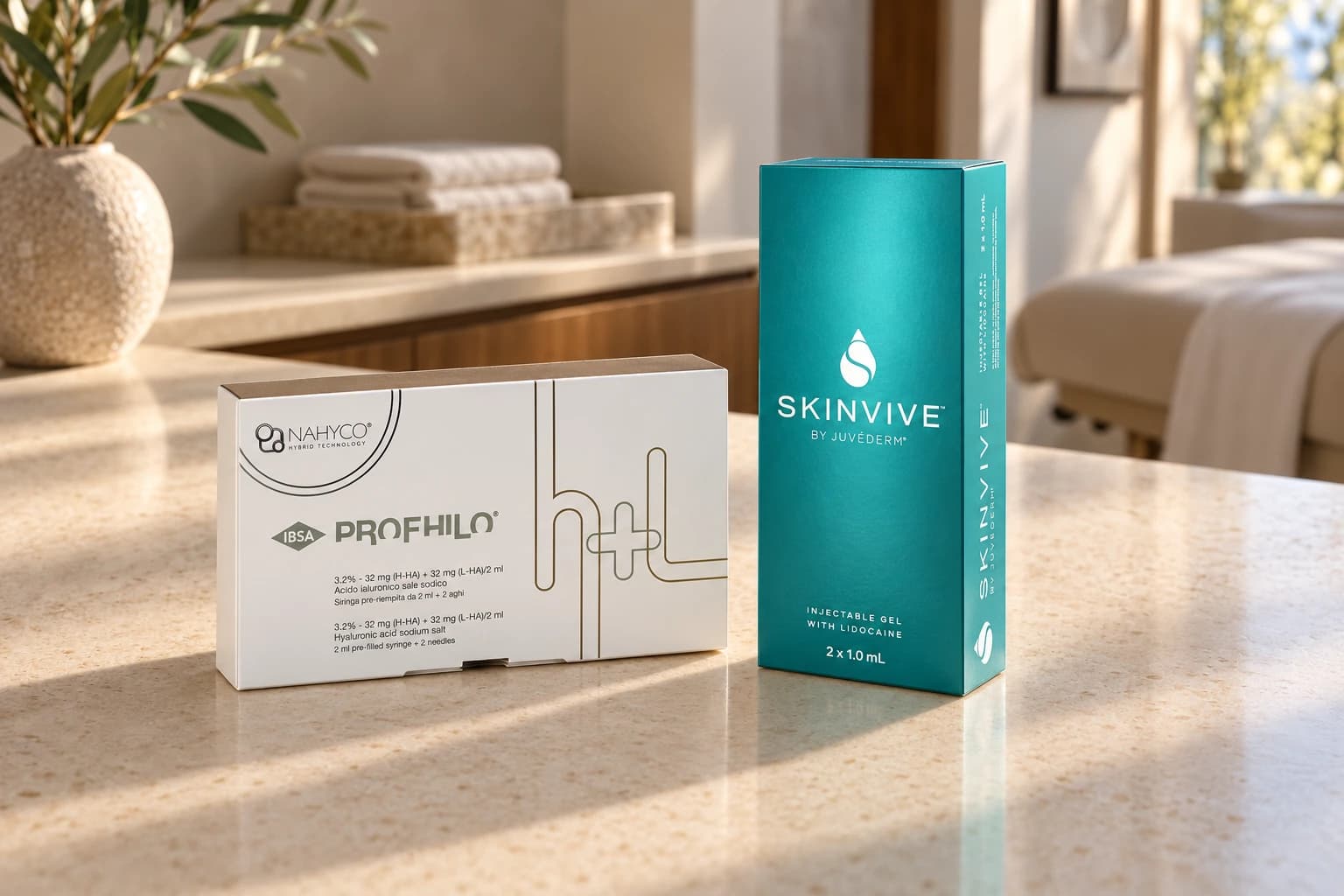
- Skinboosters: They use HA with low degree of cross-linking or micro-drops of stabilized gel that distribute homogeneously in the superficial dermis. They are injected at multiple points with micropapule or microdeposit technique. Products such as Restylane Skinbooster and Skinvive (Juvéderm) belong to this category.
- Biomodulators: Profhilo is an injectable HA product made with high- and low-molecular-weight complexes. Its manufacturer describes a specific injection protocol, including the BAP technique for some facial treatments; the indication, injection points and schedule should follow the current product instructions and the clinician’s assessment.
Protocols should not be generalized across products. FDA information for SKINVIVE reports improved cheek smoothness lasting at least six months in its clinical study. Profhilo’s instructions describe an initial two-session cycle 30 days apart, with later treatment individualized.
Hyaluronic acid and aging
The amount and distribution of HA in the skin change with age. The timing and degree vary between people and are also influenced by environmental factors such as cumulative sun exposure. Several mechanisms may contribute:
- Reduced HAS activity: The HAS1 and HAS2 enzymes, mainly responsible for HA synthesis in the dermis, reduce their activity with chronological aging.
- Fewer fibroblasts: With age, the quantity and function of dermal fibroblasts decreases, which reduces the production of HA, collagen and elastin.
- Ultraviolet damage: UV radiation decreases the expression of HAS1 and HAS2 in the dermis, while increasing the activity of hyaluronidases, the enzymes that degrade HA. This accelerates the loss of dermal HA, a process known as photoaging.
- Changes in distribution: In young skin, HA is distributed homogeneously forming a continuous network connected to collagen and elastin fibers. In aged skin, this network becomes fragmented, and HA deposits disappear from the intercellular and pericellular spaces of the dermis.
The clinical consequence of this loss is visible: the skin loses turgidity, hydration and volume, becomes thinner and wrinkles and sagging appear.
HA and health regulation
Injectable HA products are regulated as medical devices, and their authorized indications are product- and country-specific. In Mexico, verify that the exact product has a current COFEPRIS sanitary registration. FDA approval in the United States applies only to the uses, anatomical areas and age groups stated in each product’s labeling; it does not establish authorization in Mexico.
Use only traceable products from authorized channels. Treatment should be performed by a licensed, qualified healthcare professional experienced in facial anatomy, the selected product and the management of complications.
Difference between topical and injectable hyaluronic acid
| Feature | Topical HA | Injectable HA (filler) | Injectable HA (skinbooster / biomodulator) |
|---|---|---|---|
| Depth of action | Superficial epidermis | Mid-deep dermis / subcutaneous | Superficial-mid dermis |
| Objective | Hydration, luminosity | Volume, filling, contouring | Skin quality, deep hydration, firmness |
| Cross-linking | No | Yes (high) | Low or none (biomodulators) |
| Duration of effect | Requires reapplication | Varies by product; HA gels are often about 4–12 months in AAD patient guidance | Product-specific; SKINVIVE showed at least 6 months for cheek smoothness |
| Reducible with hyaluronidase | Not applicable | Sometimes; the result is not guaranteed | Sometimes; the result is not guaranteed |
| Professional application | No | Yes: a licensed, qualified healthcare professional | Yes: a licensed, qualified healthcare professional |
Sources
- Cleveland Clinic. Hyaluronic Acid: What It Is, Benefits, How To Use & Side Effects. https://my.clevelandclinic.org/health/articles/22915-hyaluronic-acid
- American Academy of Dermatology. Fillers: FAQs. https://www.aad.org/public/cosmetic/wrinkles/fillers-faqs
- American Academy of Dermatology. Fillers: Overview. https://www.aad.org/public/cosmetic/wrinkles/fillers-overview
- U.S. Food and Drug Administration. Dermal Filler Do’s and Don’ts for Wrinkles, Lips and More. https://www.fda.gov/consumers/consumer-updates/dermal-filler-dos-and-donts-wrinkles-lips-and-more
- U.S. Food and Drug Administration. Dermal Fillers (Soft Tissue Fillers). https://www.fda.gov/medical-devices/aesthetic-cosmetic-devices/dermal-fillers-soft-tissue-fillers
- U.S. Food and Drug Administration. FDA-Approved Dermal Fillers. https://www.fda.gov/medical-devices/aesthetic-cosmetic-devices/fda-approved-dermal-fillers
- U.S. Food and Drug Administration. SKINVIVE by JUVÉDERM – P110033/S059. https://www.fda.gov/medical-devices/recently-approved-devices/skinvive-juvederm-p110033s059
- COFEPRIS. Listados de Registros de Dispositivos Médicos e información relacionada. https://www.gob.mx/cofepris/documentos/registros-dispositivos-medicos
- COFEPRIS. Cofepris alerta sobre rellenador labial falsificado: grave riesgo sanitario. https://www.gob.mx/cofepris/articulos/cofepris-alerta-sobre-rellenador-labial-representa-severo-riesgo-sanitario
- IBSA Iberia. Profhilo product range: Instructions for Use. https://www.ibsaiberia.com/dam/jcr%3A03b85c36-3bba-4e6a-aa1a-cec2ce0006f7/IFU%20-%20Profhilo%20product%20range.pdf
Reviewed by our medical team
Dra. Jessica Tapia
Medical Director
Clinical content on this blog is reviewed by the Juvenalia Brío medical team for scientific accuracy and consistency with the care we provide.